A forum dedicated to the Vajrayana is now up and running.
It is called ‘Vajracakra’ and is to be found at: www.vajracakra.com .
Spread the word. Better still, join! 🙂

16 Tuesday Oct 2012
Posted in Garuda in Buddhism, Garuda LInks, Uncategorized
A forum dedicated to the Vajrayana is now up and running.
It is called ‘Vajracakra’ and is to be found at: www.vajracakra.com .
Spread the word. Better still, join! 🙂
19 Wednesday Sep 2012
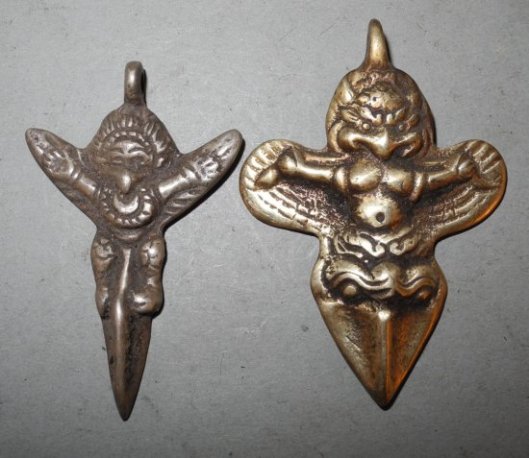
 Just received a few bronze items. They are based on Khyung Kilaya, a combination deity in which Garuda (Khyung) is supported by Vajrakilaya (or Dorje Phurba). One version is just the Garuda as a pendant (thogchag) :
AND TWO MORE KHYUNG KILAYA:
07 Tuesday Aug 2012
GARUDA AS PRACTISED IN THE DZOGCHEN COMMUNITY
of
Chögyal Namkhai Norbu Rinpoche
The Garuda emerges from its egg fully formed and ready to fly. Within Dzogchen, this is symbolic of our primordial natural state. It exists within us, already fully formed, for us to reveal.
Garuda also exists as an enlightened deity who can help us. We need help as we still exist within a world of duality and there is the potential for harm to us from other beings.
All Dzogchen Community deity practices are Anuyoga and offer a path to enlightenment. They can also be incorporated into Atiyoga practice used to reveal our true nature, the path leading to Dzogchen. We should always remember that the principal purpose for practices of an enlightened deity such as Garuda is total realisation. We should also remember that Garuda practices and mantras, like those of other enlightened beings, can be used for all purposes as long as we have confidence in using them.
There are Garuda practices for the removal of obstructions to our practice, especially illnesses and other harm from different classes of spirits, which can affect our physical and mental well-being. It is important to understand how provocations may arise and how to avoid our own negative actions.
These practices include powerful, sometimes wrathful, mantras and invocations to link us with the Garuda and his power.
GARUDA PRACTICES
There are Eight Classes of beings which may harm us through negative forces and provocations.
All Garuda forms are Enlightened Beings and can help us in a general way, and are depicted with Naga serpents held in their beaks. However, some are especially effective for particular classes.
White Garuda ( No picture available)
This Garuda is especially connected with harm from the Naga class.
Red Garuda

The Red Garuda practice is especially useful in dealing with harm from the Tsen class, which may include cancer.
Dark Blue or Black Garuda

Dark Blue Garuda practice is particularly helpful with provocations from the Yaksha class.
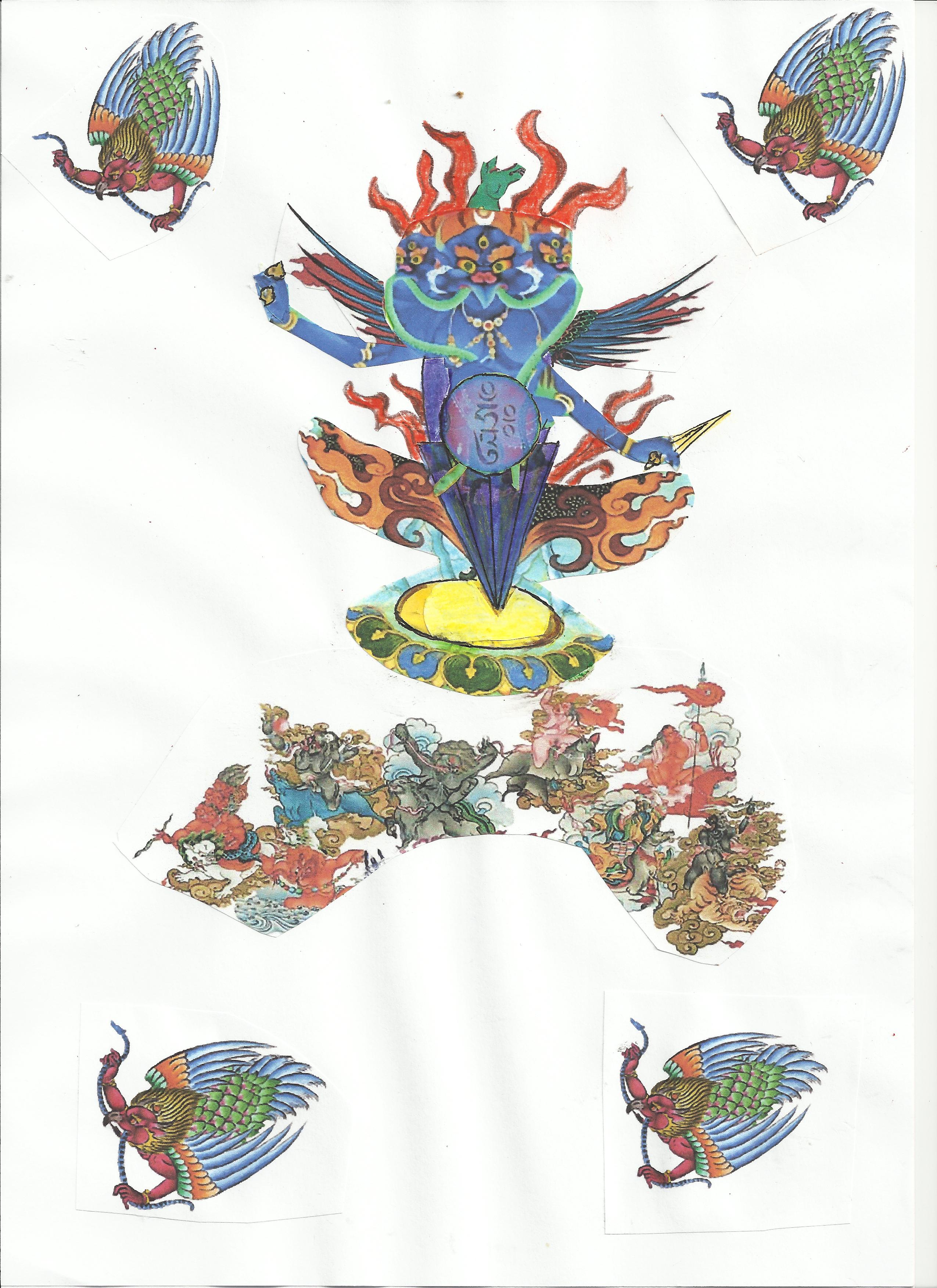
There is also a form called Takhyung Kilaya which is a dark blue Garuda with 3 faces and a kilaya lower body, like Guru Tragphur. (This is a form of Garuda incorporating Hayagriva, Vajrapani and Vajrakilaya). This is my own poor effort at an image:
Guru Tragpo
Guru Tragpo (Dragpo) is a wrathful form of Padmasambhava, combining Garuda with Hayagriva and Vajrapani. Vajrapani is for controlling celestial negative forces, Hayagriva is for controlling terrestrial negative forces, and Garuda is for controlling subterranean negative forces.
Guru Tragphur

Guru Tragphur (Dragphur) is a very powerful and wrathful form combining Garuda with Hayagriva, Vajrapani, Vajrakilaya and Yangdag Heruka. It is especially useful for extreme negative harm from the Gyalpo class.
Garuda with other Deities
Garuda also appears with other wrathful and protective deities such as Dorje Drollo (Drolod):

There is a Dzogchen Community book and mp3 on ‘THe Practice and Action Mantras of Dark Garuda, an Ebook of the same practice and a book relating to Red Garuda. They are available to members of the Dzogchen Community who have received the relevant transmissions:
Dark (Blue) Garuda Book & mp3 CD: http://www.shangshungstore.org/index.php?l=product_detail&p=490
Dark Blue Garuda Ebook and mp3 Downloads: http://www.shangshungstore.org/index.php?l=product_detail&p=491
Red Garuda Book: http://www.shangshungstore.org/index.php?l=product_detail&p=112
DZOGCHEN COMMUNITY EVENTS
There are many events relating to deities which you may attend, including Garuda ‘lung’ empowerments and Retreats for the development of good and stable practice. Familiarity with the main practice and mantra is especially important before using ‘action mantras’.
Many of the events are broadcast via internet webcast, giving access to those people unable to travel to attend in person. Some of the webcasts are ‘open’ and anyone can have access. Others are ‘closed’ and only for Members of the Dzogchen Community. Often, ‘lung’ empowerments are given during open webcasts.
However, the primary empowerment within the Dzogchen Community is that of sharing the natural state with the Guru, called Direct Introduction. This should always be a first step, in accordance with the First Statement of Garab Dorje. More information on this is easily obtained from the Dozgchen Community.
It is helpful to read an introductory text, such as’ The Crystal and the Way of Light’ by Chögyal Namkhai Norbu Rinpoche, which introduces all the main Dzogchen concepts and also offers an entertaining and informative autobiography. Copies are available from Amazon.
Membership also offers many other benefits, including access to restricted books and other media, and some discounts.
DZOGCHEN COMMUNITY LINKS
Webcasts :
http://www.shangshunginstitute.net/webcast/video.php
For information, books and resources:
http://www.shangshungintitute.net
Links to Dzogchen Community Centres: http://www.dzogchencommunity.org/links/internationalcommunity.html
The Mirror, Newspaper of the Dzogchen Community, for articles, news and events:
Other useful sites, not operated by the Dzogchen Community:
http://dzogchenworld.ning.com/
All content remains the copyright of the original holder, and I am most grateful to Chögyal Namkhai Norbu Rinpoche and to the Shang Shung Institute for their kind permission to use and summarise content from Dozgchen Community teachings.
08 Tuesday May 2012
Posted in Garuda Images, Garuda in Buddhism, Uncategorized
A friend on a Buddhist forum put this cartoon together. I love it. 🙂

29 Sunday Jan 2012
Posted in Garuda Purana Wisdom, Uncategorized
Peter Leiberson has composed music inspired by the Red Garuda. He explains:
The idea behind my second piano concerto was inspired by the Eastern mythological creature called the Red Garuda. The Red Garuda is a large bird that travels continuously — it never stops flying, and never needs to measure its flight or its distance. In mythology the Garuda represents the personal principle of not having to restrict how far one can travel or go in life’s journey. It symbolizes an absolute freedom, if you will, and its flight is not dependent on conventional limitations.
http://www.schirmer.com/default.aspx?TabId=2420&State_2874=2&workId_2874=30227
11 Friday Nov 2011
Posted in Garuda in Hinduism, Garuda Purana Wisdom, Uncategorized
I am indebted to Tormod Kinnes for kind permission to use the following material from this website: http://oaks.nvg.org/sa1ra10.html.
(Copyright remains with Tormod Kinnes. )
 |
Garuda Purana Essentials |
|||||
| 4 › 5 › 8 |  |
 |
 |
 |
 |
 |
 |
 |

Introduction
Puranas are usually written in the form of stories told by one person to someone else. Purana texts might have been written all over India, although Vyas is traditionally considered the compiler of them. Common ideas are found throughout the various Puranas. The age and origin of Puranas vary greatly, and they have been added to in the course of time as well. In Puranic texts sectarianism has crept into ancient mythology, usually with one god extolled above others. Puranas are structured similarly, but are devoted to or they extol different gods, even though various Puranas contain the same stories or similar stories. About eighteen of the many texts called ‘Puranas’ are called Mahapuranas, great puranas. Dimmitt and van Buitenen have listed twenty – the numbers in brackets are verses each contains):
There are also at least twenty Puranas more to be found.The Garuda Purana is in the Atharva-Veda and is classified as one of the Vishnu Puranas. More on Puranas
The Puranas constitute a class of literature that deals with legends of gods, asuras (demons), sages and kings of old, and contans abstracts of works in arts, sciences, medicine, grammar, dramaturgy, music, astrology and other subjects, affords insight into different phases and aspects of Hinduism – its mythology, idol-worship, theism, pantheims, love of God, philosophy, superstition, festivals and ceremonies. Puranas are “folk encyclopedies” of ancient and medieval Hinduism. [From a definition – Gpu xvi] Puranas also tell of duties among men, and they are written in an easy, flowing style. About eighteen surviving Puranas are called more important than other Puranas. The Garuda Purana is among the main ones, who – to repeat – deal with quite similar material. This means Puranas is an eclective genre. The speaker of the Garuda Purana is Garud(a), who narrates it to Kasyapa, who tells it to Vyasa, to in turn narrates it to Shiva. The work has three parts (kandas). They are Acara kanda (also called karma kanda) of 240 chapters, which deals with karma; preta kanda (dharma kanda), which deals with dharma (law, justice, etc.); and Brahma kanda (moksha kanda), which speaks of liberation, freedom (moksha) [Gpu ix-xx] The Garuda Purana was produced through several stages, and was subjected to revisions and redactions. And therefore it is difficult to fix the date of the Purana as a whole, writes J. H. Shastri. Further, as a Purana devoted to Vishnu, the Garuda Purana gives prominent place to him, before Shiva, Brahma, and other ancient, Vedic gods. Although the work describes Vishnu as the Supreme Being, that does not exclude attention to or honour of other deities. The supreme deity can be realized by knowledge and not worship (kriya), it is held (Gpu III 12:59), and the Purana holds that the individual self and the Supreme Self are identical. To realize this is liberation, explains Shastri, and tells the Lord is eternal and formless (etc.). [Gpu xxvii-xxxv]. The content of this Purana reflects a sad fact: that in the Puranic literature of AD 500 to 1000, sectarianism creeps into mythology, and one god is extolled above the others. The tendecy to theism in the Puranic universe exalts several supreme gods who are not prominent in the Vedic pantheon (the ancient assembly of gods and goddesses). Of prime interest are cosmology, myths, and ascetics who sometimes eclipse the old gods through their tapas (penance). In the Puranic world-picture the mountain Meru stands at the centre. Some interpret Mt. Meru symbolically to mean the spine. There are seven layers of heaven, and the summit of heaven is the world (loka, level) of God the Creator. Puranic myths develop around the notion of four yugas (world ages): (1) The Satya or Krita Yuga, Treta Yuga, Dvapara Yuga, and Kali-Yuga. In the order given, they show increasing deterioration of moral and features and social conditions. “The more Kali-Yuga, the more predicaments”. Each yuga has its “dawn” and “dusk” (skandas). – Tormod Kinnes
Garuda Purana Essentials
|
  Shastri, J. H. ed. The Garuda Purana, 3 Vols. Delhi: Motilal Banarsidass, 1978. Shastri, J. H. ed. The Garuda Purana, 3 Vols. Delhi: Motilal Banarsidass, 1978.
Comparesearch.eb.com/eb/article?tocId=9061934&query=puranas&ct= search.eb.com/eb/article?tocId=59831&query=puranas&ct=
|
 |
 |
 |
 |
 USER’S GUIDE to abbreviations, the site’s bibliography, letter codes, dictionaries, site design and navigation, tips for searching the site and page referrals. [LINK] USER’S GUIDE to abbreviations, the site’s bibliography, letter codes, dictionaries, site design and navigation, tips for searching the site and page referrals. [LINK]© 2005–2011, Tormod Kinnes, MA. [E-MAIL] — Disclaimer: LINK] |
08 Tuesday Nov 2011
Posted in Garuda in Other Religions, Uncategorized
Rising above the earth and soaring through the skies, birds have been symbols of power and freedom throughout the ages. In many myths and legends, birds link the human world to the divine or supernatural realms that lie beyond ordinary experience.
Birds assume a variety of roles in mythology and religion. They play a central part in some creation myths and frequently appear as messengers of the deities. They are often associated with the journey of the human soul after death. Birds also appear as tricksters and oracles. Ravens and other species that feed on carrion, the flesh of the dead, may be symbols of war, death, and misfortune, as well as mediators between humans and the supernatural world. Other birds represent strength, love, and wisdom.
Myths from several regions associate birds with the creation of the world. One of several creation stories in ancient Egypt said that when land rose out of the primeval waters of chaos, the first deity to appear was a bird perching on that land. The Egyptians called the god the Benu bird and portrayed it as a long-legged, wading heron in the sun temple at Heliopolis. The Benu bird created the universe and then made gods and goddesses and men to live in that universe.
A number of creation myths from Southeast Asia feature birds. On the great island of Borneo dwell the Iban people, who tell of Ara and Irik, two bird spirits floating above an expanse of water at the beginning of time. Seizing two eggs from the water, Ara made the sky from one egg, while Irik made the earth from the other. As Irik squeezed the earth into its proper size, mountains and rivers appeared on its surface. Then the two creator spirits shaped bits of earth into the first people and woke them to life with bird cries.
Other creation stories begin with the laying of a cosmic egg from which the universe emerges. Indonesia, Polynesia, and the northern European countries of Finland and Estonia have stories of deities flying down to the primeval ocean to lay eggs that hatch into the world.
Birds appear in some myths as earth divers. An earth diver is an animal that plunged to the bottom of the primeval sea and brought up mud from which the earth was formed. Legends of the Buriat and Samoyed people of Siberia feature birds as earth divers. Water birds such as ducks or swans play this role in the creation myths of many Native American peoples, including the Mandan of North Dakota. A Navajo myth about a great flood tells that the people fled to an upper world, leaving everything behind. The bird Turkey then dived into the lower world to rescue seeds so that the people could grow food crops.
supernatural related to forces beyond the normal world; magical or miraculous
deity god or goddess
trickster mischievous figure appearing in various forms in the folktales and mythology of many different peoples
oracle priest or priestess or other creature through whom a god is believed to speak; also the location (such as a shrine) where such words are spoken
mediator go-between
primeval from the earliest times
chaos great disorder or confusion
cosmic large or universal in scale; having to do with the universe
Sometimes mythological birds create more than the physical world. Cultures in northern Europe and Asia credited birds with establishing their social orders, especially kingships. A golden-winged eagle was said to have put the first Mongol* emperor on his throne. The Japanese believed that sacred birds guided their second emperor in conquering his enemies before the

*See Names and Places at the end of this volume for further information.
founding of his dynasty. The Magyar people claimed that a giant eagle, falcon, or hawk had led their first king into Hungary, where he founded their nation. The Magyars looked upon this bird as their mythical ancestor.
Many myths have linked birds to the arrival of life or death. With their power of flight, these winged creatures were seen as carriers or symbols of the human soul, or as the soul itself, flying heavenward after a person died. A bird may represent both the soul of the dead and a deity at the same time.
Bringers of Life and Death. Some cultures have associated birds with birth, claiming that a person’s soul arrived on earth in bird form. A remnant of this ancient belief has survived into modern times: one traditional answer to a child’s question “Where do babies come from?” is “The stork brings them.”
Birds have also been linked with death. Carrion-eating birds such as vultures, crows, and ravens, for example, were connected with disaster and war. Celtic* and Irish war goddesses often appeared in the form of crows and ravens—perhaps because crows and ravens were known to gather over battlefields and to feast on the flesh of fallen warriors. It was said that if one of these goddesses appeared before an army going into battle, the army would be defeated.
The mythological bird called the phoenix combined images of birth and death to become a powerful symbol of eternal rebirth. According to Egyptian legend, the phoenix burned up every 500 years but was then miraculously reborn out of its own ashes, so it was truly immortal. In myths from China and Japan, the phoenix does not emerge from a fire but instead causes itself to be reborn during times of good fortune.
The Flight of the Soul Numerous myths have linked birds to the journeys undertaken by human souls after death. Sometimes a bird acts as a guide in the afterlife. In Syria, figures of eagles on tombs represent the guides that lead souls to heaven. The soul guide in Jewish tradition is a dove.
In some cultures, it was thought that the soul, once freed from the body, took the form of a bird. The ancient Egyptians believed that the soul, the ba, could leave the dead body in the form of a bird, often a hawk. They built their graves and tombs with narrow shafts leading to the open air so that these birds could fly in and out, keeping watch on the body. The feather cloaks that Central American and Mexican priests and kings wore may have been connected to the idea of a soul journey.
dynasty succession of rulers from the same family or group
immortal able to live forever
imperial relating to an emperor or empire
Because of their great size and strength, eagles have been associated with royal or imperial souls. Some ancient peoples, including the Romans, would release an eagle at a ruler’s funeral. As it rose into the sky the mighty bird was seen as the ruler’s spirit taking its place in the heavens.
The Greeks and Celts thought that the dead could reappear as birds. The Sumerians of the ancient Near East believed that the dead existed as birds in the underworld. According to Islamic tradition, all dead souls remain in the form of birds until Judgment Day, while in Christian tradition, the gentle dove became a symbol of the immortal soul ascending to heaven. Birds also appear in Hindu mythology as symbols of the soul or as forms taken by the soul between earthly lives. The connection between birds and souls is sometimes reflected in language. A Turkish saying describes somebody’s death as “His soul bird has flown away.”
Becoming a Bird. Under certain conditions, the living could be transformed into birds. In some cultures, it was believed that shamans, priests, and prophets could change themselves into birds during trances or other mystical states. Such ideas were found in Siberia and Indonesia. In Celtic mythology, both deities and the sly supernatural beings called fairies or fays were said to have the power to transform themselves into birds.
Some legends involve birds that change into or inhabit the bodies of humans. The Central American god Quetzalcoatl, a combination of a bird and a serpent, appears as a culture hero or a god in human form in Toltec, Maya, and Aztec myths. Among certain peoples in northern Europe and Asia, the spirits of birds such as eagles, owls, and crows are said to enter the bodies of shamans to inspire them.
In some myths, humans and other beings acquire the ability to fly like birds. Such supernatural flight, like many mythological powers, can be either good or evil. Norse* tales told that the goddess Freya’s feather cloak enabled the wearer to fly. European tradition portrayed angels with wings like those of birds, but devils often had bat wings. Japanese mythology includes a group of winged deities known as tengu. Part bird and part human, they live in forests and occasionally use their powers to play tricks on people.
Birds in mythology sometimes have the ability to speak. These talking birds, often sources of wisdom, may be deities in bird form or simply messengers of the deities. Either way, their advice is generally sound, and humans ignore it at their peril. Birds warn of dangers ahead, reveal secrets, and guide heroes and travelers on their way.
Birds do not always speak in human languages; many stories tell of people who gain the power to understand the language of birds. In Greek mythology, a snake licked the ears of the prophet Cassandra, who could then understand what the birds were saying. After tasting the magical blood of a slain dragon, the German hero Siegfried knew what the forest birds were saying.
shaman person thought to possess spiritual and healing powers prophet one who claims to have received divine messages or insights
culture hero mythical figure who gives people the tools of civilization, such as language and fire
Some birds are believed to have special powers of telling the future or revealing the will of the gods. Magpies, ravens, and doves appear in myth as oracles. In Iranian mythology, birds communicate
*See Names and Places at the end of this volume for further information.

divine wisdom to people. The Hottentot people of southern Africa believe that the hammerhead, a wading bird, can see reflections of the future in pools of water. When the bird learns that someone is about to die, it flies to the person’s home and gives three cries of warning.
Certain birds appear over and over again in the world’s myths and legends, although not always in the same roles. The crow and its close relative the raven, for example, have a number of different meanings. In some cultures, they are oracles and symbols of death. In Norse mythology, Odin* was always accompanied by two wise ravens that told him everything that happened on earth. According to Greek mythology, the feathers of crows and ravens were originally white, but the god Apollo punished the birds—either for telling secrets or for failing in their duty as guardians—by turning them black.
Related Entries
Other entries related to birds in mythology are listed at the end of this article.
For some Native Americans, such as the Tsimshian people of the Pacific Northwest, Raven is both a trickster and a culture hero. Sometimes his antics shake up the gods and the established order of the universe, and sometimes they backfire and get him into trouble. Often, though, Raven’s deeds benefit humankind, as in the legend of how Raven brought light into the world. After finding the hiding place where the Creator kept the moon, the stars, and daylight, Raven released them so that they could shine on the world.
The majestic eagle, sometimes called the king of birds, usually has divine or royal associations in myth. Images from the ancient Near East and Iran show the sun with an eagle’s wings, a sign that the bird was linked to the sun god. The eagle was also a symbol of Jupiter, the supreme Roman deity, and a sign of strength and courage. By adopting the eagle as their symbol, kings from ancient to recent times have tried to suggest that they, too, had some divine or heroic qualities.
Stories of eagles fighting snakes or dragons represent the tension between light and darkness, heavenly and underworld forces. In the myths of various Native American peoples, the eagle is a culture hero, a hunter or a tornado transformed into a bird, and the spirit of war and hunting. The eagle was also the great culture hero of Siberian mythology
In the ancient Near East and in Greece, the dove was a symbol of love and fertility, often associated with goddesses of love such as the Greek Aphrodite. In China doves represent tranquility and faithfulness in marriage, while in India they symbolize the soul.
When owls appear in mythology, their meaning is often uncertain and complex, neither all good nor all bad. Owls are symbols of wisdom, patience, and learning, yet because they hunt at night, they are associated with secrecy and darkness. In China they are seen as signs of coming misfortune. According to the Hottentot people of Africa, the hooting of an owl at night is an omen of death.
Early cultures in Mexico regarded owls as sacred to the rain god, but later the Aztecs of the same region viewed them as evil night demons. Some Native American legends portray owls as destructive and malicious; others show them as helpful beings who warn people of dangers. The stories may include a person who is transformed into an owl. In the Navajo creation myth, an owl resolves a bitter quarrel between men and women, allowing the creation of the human race.
Bats also symbolize both good and evil in mythology. Chinese legends link the bat with good fortune. A group of five bats represents five causes of happiness: wealth, health, long life, virtue, and a natural death. In various other cultures, however, bats are often connected with witches or evil spirits, and demons are pictured with bat wings.
Jewish mythology includes the story of the hoyl—a bird that, like the phoenix, is devoured by divine fire only to rise from its own ashes. Legend says that after Adam and Eve ate the forbidden fruit in the Garden of Eden, Adam offered the fruit to all of the animals. The hoyl bird was the only one that refused to eat the fruit that God had said must never be eaten. As a reward, the hoyl received a kind of immortality. It never dies but only goes to sleep, after which fire destroys it. An egg remains, however, and from that egg a full-grown hoyl hatches anew.
Other birds have special meanings in myths. Swans, with their white feathers and graceful appearance, often serve as symbols of purity and feminine beauty. Both Celtic and Norse mythology included tales of women who turned into swans. Male peacocks, endowed with splendid tail feathers, can suggest either foolish vanity or divine glory. In legends from India, they often appear being ridden by one of the gods.
See also Afterlife ; Animals in Mythology ; Creation Stories ; Firebird ; Phoenix ; Quetzalcoatl ; Thunderbird .
Source of the above:
Myths Encyclopedia » Be-Ca » Birds in Mythology – Myth Encyclopedia
http://www.mythencyclopedia.com/Be-Ca/Birds-in-Mythology.html
I have been unable to ascertain the copyright holder of this information. Please contact me if you are the copyright holder at bluegarudas@gmail.com
01 Tuesday Nov 2011
 Karura 迦楼羅, Karura-Ō 迦楼羅王 (Skt. = Garuda) Bird of Life, Celestial Eagle, Half Bird Half ManORIGIN = HINDU MYTHOLOGY Member of the TENBU. One of EIGHT LEGIONS Guarding Buddhism. One of 28 LEGIONS Guarding the 1000-ARMED KANNON BODHISATTVA. One of KANNON’S 33 BASIC MANIFESTATIONS.
Karura 迦楼羅
Karyōbinga (Skt. = Kalavinka) 迦陵頻伽 LEARN MORE
|
|
||||||||||||||||
 |
|
27 Thursday Oct 2011
Posted in Uncategorized
I have added the information form Wikipedia to the ‘Garuda Resources’ page and will add other sources and update them soon. 🙂
 A Purana is a holy text among Hindus (and Buddhists and Jains). The word purana means “of ancient times”. Puranans are old works, a group of religious texts. There are many puranas. What most of them have in common, is a build-up that tells of creation, genealogies of the kings, heroes, sages, and demigods, and describes Hindu cosmology, philosophy, and geography. In other words, a Purana is a collection of myth, legend, and genealogy, and tells versions of how the world was made.

 The most unfortunate women sinned against their husbands
 The amount of sleep, fears, and riches is not evenly distributed among people. City folks tend to suffer most.
 Going for wealth, delicate pleasures, and freedom are worthy goals in Hinduism. Do not wait to secure your happiness, then.
 Unfortunate women sin against their husbands, and then by stages get whiny, nervous and fearful and mad as a result. Wise women, on the other hand, secure their calm and happiness by reciting mantras, doing daily chores like milking, keeping good company, and thinking of God. They may also reach right action.


 Sanskrit = Garuḍa (the Devourer), Chinese = Jiālóuluó


 Khyung Garuda ཁྲོཾ