• Garuda Dandakam
  • Garuda Purana – wisdom teachings
  • Garuda Resources
  • Garuda Rituals

Khyung Garuda ཁྲོཾ

~ Garudapedia – for all things Garuda

Khyung Garuda ཁྲོཾ

Category Archives: Garuda Images

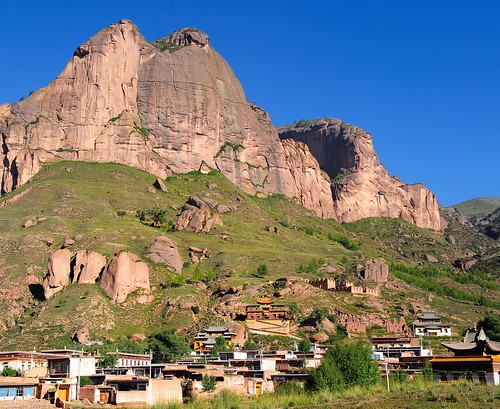
Blue Garuda Mountain (Khyung-ngon)

14 Monday Nov 2011

Posted by Mantrik in Garuda Images, Garuda in Buddhism

≈ Leave a comment

Mount Khyung-ngon (Blue Garuda) is a broad cliff behind Rabgya monastery to the north, to the south the river Ma chu རྨ་ཆུ་ ( Yellow River). There is a walk to the hilltop shrine (3570 m) and passes several smaller shrines and caves, giving a good view of the river.

Above: Rabgya monastery and the Mountain Khyung-ngon (Blue Garuda)

Rabgya Monastery (locally pronounced Rabja) is a small enclave on the north bank of the river Ma chu རྨ་ཆུ་ ( Yellow River) belonging to Machen rather than Kawasumdo county.Rabgya Monastery formally known as Tashi Kundeling, is an important branch of Sera monastery, founded on the advice of the Seventh Dalai Lama in 1769 by a Mongolian from Kokonor named Arik Geshe (1726-1803). Even today there are sevaral monks from the Sogwo Mongolian prefecture just to the east. The complex has been substantially rebuilt during the last 13 years, and reconstruction continues even now.

Other Views

All pictures on this post are shown with kind permission from Jan Reurink. His extensive photography may be seen by following this link to his copyright work:

Rabgya monastery and the Mountain Khyung-ngon (Blue Garuda)

Like to see the pictures as Large as your screen? Than why not click on the Slideshow : www.flickr.com/photos/reurinkjan/sets/72157622436074363/s…


Similar Winged Deities

02 Wednesday Nov 2011

Posted by Mantrik in Garuda Images, Garuda in Other Religions

≈ Leave a comment


I have selected a few religious figures which are particularly significant. For the moment, information is from Wikipedia, reproduced here for convenience.

FARAVAHAR

From Wikipedia, the free encyclopedia

Stone carved Faravahar in Persepolis.
Faravahar-Gold.svg
The faravahar.
Part of a series on
Zoroastrianism
Primary topics
Zoroastrianism
Ahura Mazda
Zarathustra
aša (asha) / arta
Angels and demons
Amesha Spentas · Yazatas
Ahuras · Daevas
Angra Mainyu
Scripture and worship
Avesta
Gathas · Yasna
Vendidad · Visperad
Yashts · Khordeh Avesta
Ab-Zohr
The Ahuna Vairya Invocation
Fire Temples
Accounts and legends
Dēnkard · Bundahišn
Book of Arda Viraf
Book of Jamasp
Story of Sanjan
History and culture
Zurvanism
Calendar · Festivals
Marriage
Eschatology
Adherents
Zoroastrians in Iran
Parsis · Iranis
• • •
Persecution of Zoroastrians
See also
Index of Related Articles

Faravahar (OP *fravarti > MP: prʾwhr)[1] is one of the best-known symbols of Zoroastrianism, the state religion of ancient Iran. This religious-cultural symbol was adapted by the Pahlavi dynasty to represent the Iranian nation.

The etymology of Faravahar is the Middle Persian root /frwr/ (the Pahlavi script of Middle Persian did not represent short vowels), and the word is thus variously pronounced/written farohar, frohar, frawahr, fravahr and so forth, as there is no agreed upon method of transliterating the Middle Persian word into English. In Dekhoda’s dictionary and the 17th century Persian dictionary Burhan Qati’, it appears as فروهر “furuhar”. The Encyclopedia Iranica renders it as frawahr (this reflects the Pazend dibacheh form, corresponding to Book Pahlavi prʾwhr).

The winged disc has a long history in the art and culture of the ancient Near and Middle East. Historically, the symbol is influenced by the “winged sun” hieroglyph appearing on Bronze Age royal seals (Luwian SOL SUUS, symbolizing royal power in particular)[citation needed]. In Neo-Assyrian times, a human bust is added to the disk, the “feather-robed archer” interpreted as symbolizing Ashur.

While the symbol is currently thought to represent a Fravashi (c. a guardian angel) and from which it derives its name (see below), what it represented in the minds of those who adapted it from earlier Mesopotamian and Egyptian reliefs is unclear. Because the symbol first appears on royal inscriptions, it is also thought to represent the ‘Divine Royal Glory’ (khvarenah), or the Fravashi of the king, or represented the divine mandate that was the foundation of a king’s authority.

This relationship between the name of the symbol and the class of divine entities it represents, reflects the current belief that the symbol represents a Fravashi. However, there is no physical description of the Fravashis in the Avesta, the sacred texts of Zoroastrianism, and in Avestan the entities are grammatically feminine.

In present-day Zoroastrianism, the faravahar is said to be a reminder of one’s purpose in life, which is to live in such a way that the soul progresses towards frasho-kereti, or union with Ahura Mazda, the supreme divinity in Zoroastrianism. Although there are a number of interpretations of the individual elements of the symbol, none of them are older than the 20th century.

  • Persepolis, Iran.

  • A Neo-Assyrian “feather robed archer” figure, symbolizing Ashur. The right hand is extended similar to the Faravahar figure, while the left hand holds a bow instead of a ring (9th or 8th c. BC relief).

  • The Faravahar portrayed in the Behistun Inscription

  • National bank of Iran (1946) containing the Farvahar icon.

  • Recent image of National Bank of Iran.

  • Tomb of Ferdowsi in Mashhad/Tous, Iran, containing Farvahar icon.

  • A Zoroastrian fire temple in Yazd, Iran.

In Iranian Culture

Even after the Islamic conquest of Persia Zoroastrianism continued to be part of Iranian culture in which throughout the year festivities are celebrated such as the Persian New Year or Nowrouz, Mehregan and ChaharShanbe Souri which are remnants of Zoroastrian traditions. From the start of the 20th century the Farvahar icon found itself in public places and became a known icon amongst all Iranians. The Shahname by Ferdowsi is Iran’s national epic and contains stories (partly historical and partly mythical) from pre-islamic Zoroastrian times. The tomb of Ferdowsi which is visited by numerous Iranians every year, contains the Farvahar icon as well.

After the Islamic Revolution of 1979 the Lion and Sun which was part of Iran’s original national flag had been banned by the government from public places in order to prevent people from being reminded of life prior to the revolution, nevertheless Farvahar icons were not removed. As a result, the Farvahar icon became a national symbol amongst the people which became somewhat tolerated by the government compared to the Lion and Sun. The Farvahar is the most worn pendant amongst Iranians and has become a national symbol rather than a religious icon, although it’s Zoroastrian roots are certainly not ignored.

  • Photo taken of a Zoroastrian Iranian in Tehran, Iran during the festivities of Mehregan.

  • A Zoroastrian Iranian in New York, wearing a Farvahar pendant.

  • An artwork from Iran depicting the Farvahar icon.

  • A young man wearing a Farvahar tattoo on his back.

  • Imperial coat of arms prior to the Revolution, containing Farvahar icon.

References

  1. ^ The Encyclopedia Iranica gives several Middle Iranian renderings: fraward, frawahr, frōhar, frawaš, frawaxš. The form frawahr reflects the Pazend dibacheh form, corresponding to Book Pahlavi prʾwhr).
Retrieved from “http://en.wikipedia.org/w/index.php?title=Faravahar&oldid=453698306“
Categories:

  • Zoroastrian symbols
  • National symbols of Iran
  • Persian loanwords
  • Persian words and phrases
  • This page was last modified on 3 October 2011 at 13:47.
  • Text is available under the Creative Commons Attribution-ShareAlike License; additional terms may apply. See Terms of use for details.
    Wikipedia® is a registered trademark of the Wikimedia Foundation, Inc., a non-profit organization.


HORUS

From Wikipedia, the free encyclopedia
Horus

Horus was often the ancient Egyptians’ national patron god. He was usually depicted as a falcon-headed man wearing the pschent, or a red and white crown, as a symbol of kingship over the entire kingdom of Egypt.
God of the king, the sky and vengeance
Major cult center Nekhen, Behdet Edfu
Symbol The wedjat eye
Parents Osiris and Isis in some myths, and Nut and Geb in others.
Siblings Anubis (in some accounts) or Osiris, Isis, and Nephthys
Consort Hathor (in one version)

Horus is one of the oldest and most significant deities in the Ancient Egyptian religion, who was worshipped from at least the late Predynastic period through to Greco-Roman times. Different forms of Horus are recorded in history and these are treated as distinct gods by Egyptologists.[1] These various forms may possibly be different perceptions of the same multi-layered deity in which certain attributes or syncretic relationships are emphasized, not necessarily in opposition but complementary to one another, consistent with how the Ancient Egyptians viewed the multiple facets of reality.[2]

The earliest recorded form is Horus the Falcon who was the patron deity of Nekhen in Upper Egypt and who is the first known national god, specifically related to the king who in time came to be regarded as a manifestation of Horus in life and Osiris in death.[1] The most commonly encountered family relationship describes Horus as the son of Isis and Osiris but in another tradition Hathor is regarded as his mother and sometimes as his wife.[1] Horus served many functions in the Egyptian pantheon, most notably being the god of the Sky, god of War and god of Protection.

Contents

  • 1 Etymology
  • 2 Horus and the Pharaoh
  • 3 Origin mythology
  • 4 Mythological roles
    • 4.1 Sky god
    • 4.2 God of war and hunting
    • 4.3 Conqueror of Set
    • 4.4 Heru-pa-khered (Horus the Younger)
    • 4.5 Heru-ur (Horus the Elder)
  • 5 See also
  • 6 References
  • 7 External links

Etymology

G5
ḥr “Horus”
in hieroglyphs

Horus is recorded in Egyptian hieroglyphs as ḥr.w and is reconstructed to have been pronounced *Ḥāru, meaning “Falcon”. As a description it has also typically been thought of as having the meaning “the distant one” or “one who is above, over”.[3] By Coptic times, the name became Hōr. It was adopted into Greek as Ὥρος Hōros. The original name also survives in later Egyptian names such as Har-Si-Ese literally “Horus, son of Isis”.

Horus was also sometimes known as Nekheny, meaning “falcon”. Some have proposed that Nekheny may have been another falcon-god, worshipped at Nekhen (city of the hawk), but then Horus was identified with him early on. As falcon, Horus may be shown on the Narmer Palette dating from the time of unification of upper and lower Egypt.

Horus and the Pharaoh

Pyramid texts ca. the 25th Century BC describe the nature of the Pharaoh in different characters as both Horus and Osiris. The Pharaoh as Horus in life became the Pharaoh as Osiris in death, where he was united with the rest of the gods. New incarnations of Horus succeeded the deceased pharaoh on earth in the form of new Pharaohs.

The lineage of Horus, the eventual product of unions between the children of Atum, may have been a means to explain and justify Pharaonic power; The gods produced by Atum were all representative of cosmic and terrestrial forces in Egyptian life; by identifying Horus as the offspring of these forces, then identifying him with Atum himself, and finally identifying the Pharaoh with Horus, the Pharaoh theologically had dominion over all the world.

The notion of Horus as the Pharaoh seems to have been superseded by the concept of the Pharaoh as the son of Ra during the Fifth Dynasty of Egypt.[4]

Origin mythology

Horus was born to the goddess Isis after she retrieved all the dismembered body parts of her murdered husband Osiris, except his penis which was thrown into the Nile and eaten by a catfish,[5][6] and used her magic powers to resurrect Osiris and fashion a gold phallus[7] to conceive her son. Once Isis knew she was pregnant with Horus, she fled to the Nile Delta marshlands to hide from her brother Set who jealously killed Osiris and who she knew would want to kill their son.[8] There Isis bore a divine son, Horus.

Mythological roles

G9 N27
N27
rˁ-ḥr-3ḫty “Re-Harachte”
in hieroglyphs

Horus represented in relief with Wadjet and wearing the double crown – temple of Hatshepsut

Horus Falcon Statue from Hatshepsut’s temple

Horus relief in the temple of Edfu

Sky god

Horus depicted as a falcon

Since Horus was said to be the sky, he was considered to also contain the sun and moon. It became said that the sun was his right eye and the moon his left, and that they traversed the sky when he, a falcon, flew across it. Thus he became known as Harmerty – Horus of two eyes. Later, the reason that the moon was not as bright as the sun was explained by a tale, known as the contestings of Horus and Set, originating as a metaphor for the conquest of Upper Egypt by Lower Egypt in about 3000 BC. In this tale, it was said that Set, the patron of Upper Egypt, and Horus, the patron of Lower Egypt, had battled for Egypt brutally, with neither side victorious, until eventually the gods sided with Horus (see below).

As Horus was the ultimate victor he became known as Harsiesis, Heru-ur or Har-Wer (ḥr.w wr ‘Horus the Great’), but more usually translated as Horus the Elder. In the struggle Set had lost a testicle, explaining why the desert, which Set represented, is infertile. Horus’ left eye had also been gouged out, which explained why the moon, which it represented, was so weak compared to the sun.

It was also said that during a new-moon, Horus had become blinded and was titled Mekhenty-er-irty (mḫnty r ỉr.ty ‘He who has no eyes’). When the moon became visible again, he was re-titled Khenty-irty (ḫnty r ỉr.ty ‘He who has eyes’).

Horus was occasionally shown in art as a naked boy with a finger in his mouth sitting on a lotus with his mother. In the form of a youth, Horus was referred to as Neferhor. This is also spelled Nefer Hor, Nephoros or Nopheros (nfr ḥr.w) meaning ‘The Good Horus’.

Wedjat, eye of Horus

The Eye of Horus is an ancient Egyptian symbol of protection and royal power from deities, in this case from Horus or Ra. The symbol is seen on images of Horus’ mother, Isis, and on other deities associated with her.

In the Egyptian language, the word for this symbol was “Wedjat”.[9][10] It was the eye of one of the earliest of Egyptian deities, Wadjet, who later became associated with Bast, Mut, and Hathor as well. Wedjat was a solar deity and this symbol began as her eye, an all seeing eye. In early artwork, Hathor is also depicted with this eye.[11] Funerary amulets were often made in the shape of the Eye of Horus. The Wedjat or Eye of Horus is “the central element” of seven “gold, faience, carnelian and lapis lazuli” bracelets found on the mummy of Shoshenq II.[12] The Wedjat “was intended to protect the king [here] in the afterlife”[12] and to ward off evil. Ancient Egyptian and Near Eastern sailors would frequently paint the symbol on the bow of their vessel to ensure safe sea travel.[13]

God of war and hunting

Part of a series on
Ancient Egyptian
religion
Eye of Horus
Main beliefs
Mythology · Soul · Duat · Ma’at
Numerology
Practices
Temples · Offering formula · Funerals
Deities
Amun · Amunet · Anubis · Anuket
Apep · Apis · Aten · Atum · Bastet
Bat · Bes · Four sons of Horus
Geb · Hapy · Hathor · Heka · Heqet
Horus · Isis · Khepri · Khnum
Khonsu · Kuk · Maahes · Ma’at
Mafdet · Menhit · Meretseger
Meskhenet · Monthu · Min · Mnevis
Mut · Neith · Nekhbet · Nephthys
Nu · Nut · Osiris · Pakhet · Ptah
Qebui · Ra · Ra-Horakhty · Reshep
Satis · Sekhmet · Seker · Selket
Sobek · Sopdu · Set · Seshat · Shu
Tatenen · Taweret · Tefnut · Thoth
Wadjet · Wadj-wer · Wepwawet
Wosret
Texts
Amduat · Books of Breathing
Book of Caverns · Book of the Dead
Book of the Earth · Book of Gates
Book of the Netherworld
Related topics
Atenism · Curse of the Pharaohs

Ancient Egypt portal


Horus was also said to be a god of war and hunting. The Horus falcon is shown upon a standard on the predynastic Hunters Palette in the “lion hunt”.

Thus he became a symbol of majesty and power as well as the model of the pharaohs.[14] The Pharaohs were said to be Horus in human form.

Furthermore Nemty, another war god, was later identified as Horus.[15]

Conqueror of Set

Horus was told by his mother, Isis, to protect the people of Egypt from Set, the god of the desert, who had killed his father Osiris.[16][17][18]

Horus had many battles with Set, not only to avenge his father, but to choose the rightful ruler of Egypt. In these battles, Horus came to be associated with Lower Egypt (where Horus was worshipped), and became its patron.

One scene stated how Horus was on the verge of killing Set; but his mother (and Set’s sister), Isis, stopped him. Isis injured Horus, but eventually healed him.[19]

According to Papyrus Chester-Beatty I, Set is depicted as trying to prove his dominance by seducing Horus and then having intercourse with him. However, Horus places his hand between his thighs and catches Set’s semen, then subsequently throws it in the river, so that he may not be said to have been inseminated by Set. Horus then deliberately spreads his own semen on some lettuce, which was Set’s favorite food. After Set had eaten the lettuce, they went to the gods to try to settle the argument over the rule of Egypt. The gods first listened to Set’s claim of dominance over Horus, and call his semen forth, but it answered from the river, invalidating his claim. Then, the gods listened to Horus’ claim of having dominated Set, and call his semen forth, and it answered from inside Set.[20][21]

However, Set still refused to relent, and the other gods were getting tired from over eighty years of fighting and challenges. Horus and Set challenged each other to a boat race, where they each raced in a boat made of stone. Horus and Set agreed, and the race started. But Horus had an edge: his boat was made of wood painted to resemble stone, rather than true stone. Set’s boat, being made of heavy stone, sank, but Horus’s did not. Horus then won the race, and Set stepped down and officially gave Horus the throne of Egypt.[19] But after the New Kingdom, Set still was considered Lord of the desert and its oases.[22]

This myth, along with others, could be seen as an explanation of how the two kingdoms of Egypt (Upper and Lower) came to be united. Horus was seen as the God of Lower Egypt, and Set as the God of Upper Egypt. In this myth, the respective Upper and Lower deities have a fight, through which Horus is the victor. However, some of Horus (representing Lower Egypt) enters into Set (Upper Egypt) thus explaining why Lower Egypt is dominant over Upper Egypt. Set’s regions were then considered to be of the desert.

Heru-pa-khered (Horus the Younger)

Horus the Younger, Harpocrates to the Ptolemaic Greeks, is represented in the form of a youth wearing a lock of hair (a sign of youth) on the right of his head. In addition, he usually wears the united crowns of Egypt, the crown of upper Egypt and the crown of lower Egypt. He is a form of the rising sun, representing its earliest light.

Heru-ur (Horus the Elder)

Horus, (Louvre Museum), ‘Shen rings‘ in his grasp

In this form he represented the god of light and the husband of Hathor. He was one of the oldest gods of ancient Egypt. He became the patron of Nekhen (Heirakonpolis) and the first national god (God of the Kingdom). Later, he also became the patron of the pharaohs, and was called the son of truth.[23] – signifying his role as an important upholder of Maat. He was seen as a great falcon with outstretched wings whose right eye was the sun and the left one was the moon. In this form, he was sometimes given the title Kemwer, meaning (the) great black (one).

The Greek form of Heru-ur (or Har wer) is Haroeris. Other variants include Hor Merti ‘Horus of the two eyes’ and Horkhenti Irti.[24]

See also

  • Egyptian pantheon
  • Heru-ra-ha
  • Jesus Christ in comparative mythology – contains a study of similarities between Horus and Jesus.
  • Myth of Osiris and Isis

References

  1. ^ a b c “The Oxford Guide: Essential Guide to Egyptian Mythology”, Edited by Donald B. Redford, Horus: by Edmund S. Meltzer, p164–168, Berkley, 2003, ISBN 0-425-19096-x
  2. ^ “The Oxford Guide: Essential Guide to Egyptian Mythology”, Edited by Donald B. Redford, p106 & p165, Berkley, 2003, ISBN 0-425-19096-x
  3. ^ Meltzer, Edmund S. (2002). Horus. In D. B. Redford (Ed.), The ancient gods speak: A guide to Egyptian religion (pp. 164). New York: Oxford University Press, USA.
  4. ^ Samuel Noah Kramer. Mythologies of the Ancient World. Quadrangle Books: Chicago, 1961. pp. 35–43
  5. ^ New York Folklore Society (1973). “New York folklore quarterly”. 29. Cornell University Press. p. 294.
  6. ^ Ian Shaw (2003). The Oxford History of Ancient Egypt. Oxford University Press. ISBN 0-19-815034-2.
  7. ^ Piotr O. Scholz (2001). Eunuchs and castrati: a cultural history. Markus Wiener Publishers. p. 32. ISBN 1-55876-201-9.
  8. ^ Roy G. Willis (1993). World mythology. Macmillan. p. 43. ISBN 0-8050-2701-7.
  9. ^ Pommerening, Tanja, Die altägyptischen Hohlmaße (Studien zur Altägyptischen Kultur, Beiheft 10), Hamburg, Helmut Buske Verlag, 2005
  10. ^ M. Stokstad, “Art History”
  11. ^ Lady of the West at hethert.org
  12. ^ a b Silverman, op. cit., p.228
  13. ^ Charles Freeman, The Legacy of Ancient Egypt, Facts on File, Inc. 1997. p.91
  14. ^ Egypt: Gods of Ancient Egypt Main Menu
  15. ^ The Contendings of Horus and Seth
  16. ^ Ancient Egyptian Culture
  17. ^ The Gods of Ancient Egypt – Horus
  18. ^ Ancient Egypt: the Mythology – Horus
  19. ^ a b Mythology, published by DBP, Chapter: Egypt’s divine kingship
  20. ^ Theology WebSite: The 80 Years of Contention Between Horus and Set
  21. ^ Fleming, Fergus, and Alan Lothian. The Way to Eternity: Egyptian Myth. Duncan Baird Publishers, 1997. pp. 80–81
  22. ^ Set, God of Confusion, by TeVelde
  23. ^ Heru-ur; Horus the Elder
  24. ^ Patricia Turner, Charles Russell Coulter, Dictionary of ancient deities, 2001

External links

  • UCAR educational article about Horus
Retrieved from “http://en.wikipedia.org/w/index.php?title=Horus&oldid=458486627“
Categories:

  • Egyptian gods
  • Solar gods
  • Sky and weather gods
  • Savior gods
  • War gods
  • Hellenistic Egyptian deities
  • Mythological birds of prey
  • This page was last modified on 1 November 2011 at 16:59.
  • Text is available under the Creative Commons Attribution-ShareAlike License; additional terms may apply. See Terms of use for details.
    Wikipedia® is a registered trademark of the Wikimedia Foundation, Inc., a non-profit organization.

PAZUZU

Deities, demons and spirits are sometimes depicted in combination form, i.e. the head of one animal, the body of another.  Garuda is no exception.  In this case, the being Pazuzu is a demon, but can also be called upon for protection:

From Wikipedia, the free encyclopedia:

Assyrian demon Pazuzu, first millennium BC, Louvre Museum.

In Assyrian and Babylonian mythology, Pazuzu (sometimes Fazuzu or Pazuza) was the king of the demons of the wind, and son of the god Hanbi. He also represented the southwestern wind, the bearer of storms and drought.

Contents

  • 1 Iconography
  • 2 Mythology
  • 3 In modern culture
  • 4 References
  • 5 External links

Iconography

Pazuzu is often depicted as a combination of diverse animal and human parts. He has the body of a man, the head of a lion or dog, eagle-like taloned feet, two pairs of wings, a scorpion‘s tail, and a serpentine penis. He is often depicted with his right hand pointing upward, and left hand pointing down.

Mythology

Pazuzu is the demon of the southwest wind known for bringing famine during dry seasons, and locusts during rainy seasons. Pazuzu was said to be invoked in amulets which combat the powers of his wife,[1] the malicious goddess Lamashtu, who was believed to cause harm to mother and child during childbirth. Although Pazuzu is, himself, an evil spirit, he drives away other evil spirits, therefore protecting humans against plagues and misfortunes.

Wilfred Lambert (1968) identified a fibula with a Pazuzu head at Megiddo [2] and also a Sumerian-Akkadian invocation.[3]

In modern culture

Main article: Pazuzu (The Exorcist)

In the 1971 novel The Exorcist and the movie based on the novel, Pazuzu is supposedly one of the evil spirits that possesses the young girl Regan MacNeil. He reappears in the 1977 sequel Exorcist II: The Heretic. In this movie, Pazuzu is both named as the demon antagonist of Regan MacNeil and the unwitting helper of Father Philip Lamont (played by Richard Burton), as he seeks to finally free Regan from his hold. In the end, Father Lamont finally defeats the demons.

Pazuzu appears on the album cover of the Gorillaz compilation album D-Sides and as a statue in front of the band’s former recording studio, as well as in the promo video for the band’s song Dare, the promo video for the song Rockit, and the unmade promo video for Rhinestone eyes.

In his author’s bio in the first issue of Warrior magazine in 1982, comic book author Alan Moore claims to be “possessed by the demon Pazuzu.”

Pazuzu is the demon that haunts Adèle Blanc-Sec in Tardi‘s graphic novel “The Demon of the Eiffel Tower” (“Le Démon de la tour Eiffel,” 1976). Pazuzu also appears in “Mummies on Parade” (“Momies en folie,” 1978).

In the TV series Futurama, Pazuzu is the name of Professor Farnsworth‘s gargoyle in the 2003 episode Teenage Mutant Leela’s Hurdles.

References

  1. ^ “Statuette of the demon Pazuzu with an inscription”. Louvre website. Retrieved 2010-05-18.
  2. ^ Lambert, W. L. 1968. Inscribed Pazuzu Heads from Babylon. Forschungen und Berichte 10: 417 1970)
  3. ^ “1970 hat WG Lambert, FuB 12 (1970), S. 41-47 eine sumerisch- akkadische Pazuzu-Beschwörung rekonstruiert”

External links

  • Oriental Institute of Chicagofigure of Pazuzu
Retrieved from “http://en.wikipedia.org/w/index.php?title=Pazuzu&oldid=502014632“
Categories:

  • Mesopotamian demons
  • Mesopotamian mythology
  • Sky and weather gods
  • This page was last modified on 13 July 2012 at 06:41.
  • Text is available under the Creative Commons Attribution-ShareAlike License; additional terms may apply. See Terms of use for details.
    Wikipedia® is a registered trademark of the Wikimedia Foundation, Inc., a non-profit organization.

Garuda as Griffin (Gryphon)

02 Wednesday Nov 2011

Posted by Mantrik in Garuda Images, Garuda in Other Religions

≈ Leave a comment

Introduction

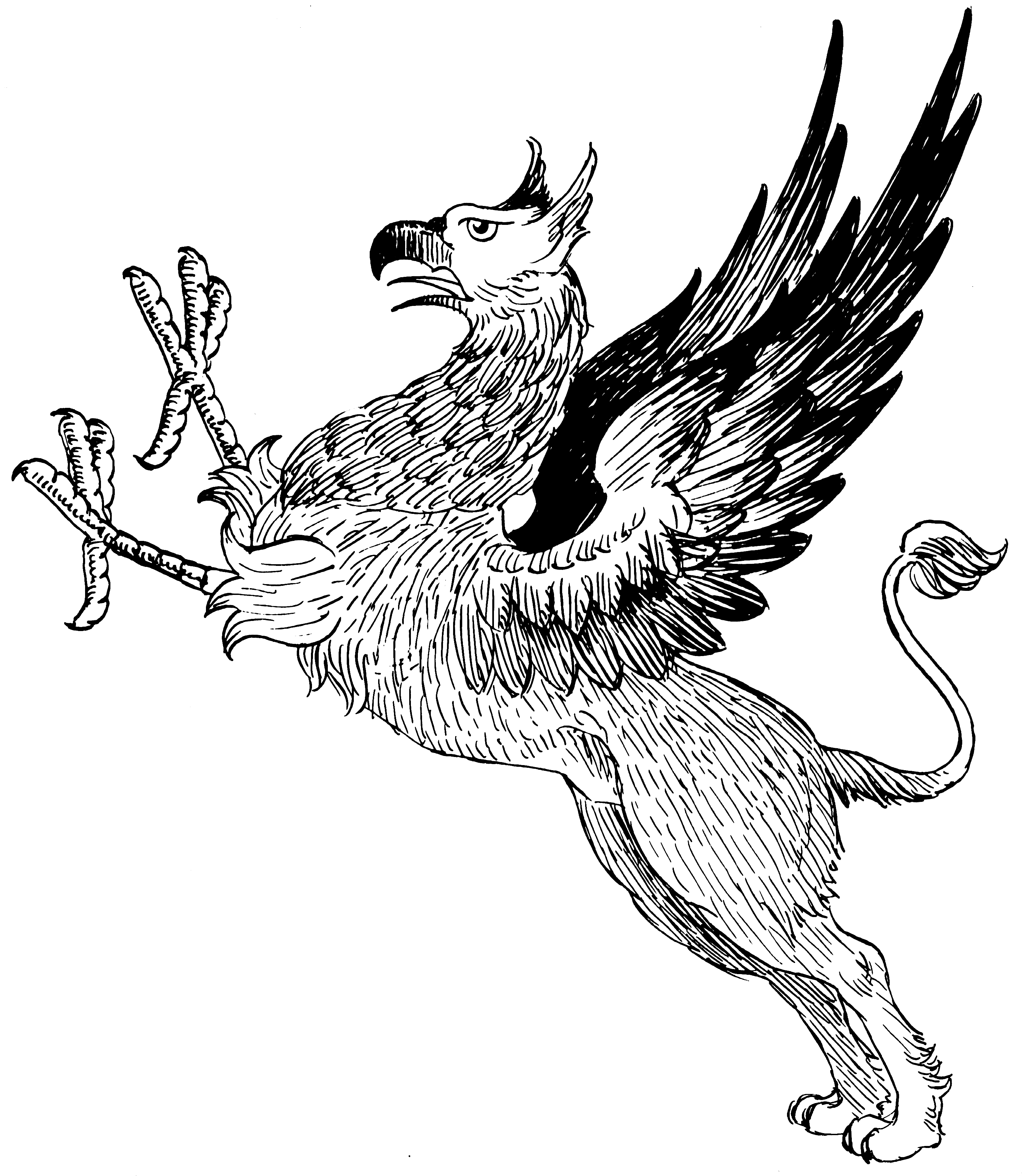
Appearing in mythology across the world the Gryphon is a winged being with a lion’s body and an eagle’s beaked head.  Sometimes the front legs are also those of an eagle.

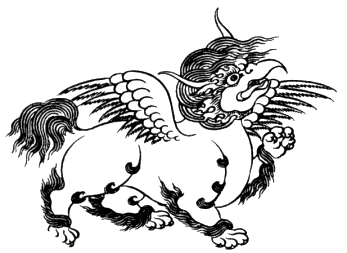
The similarity with the Tibetan Buddhist being with a Garuda’s head and wings, and the body of a Snow Lion, is surely far too similar to be coincidental.

Some sources agree that the origin of the Griffin is India. It may seem surprising, as we mainly hear of tigers in India, but a small population of lions still exists to this day.

However, a scan of the Wiki article reveals many such eagle/lion beings of great antiquity across many cultures.

The Griffin, like the Garuda, is often a representation of Wisdom, and of fierce bravery   – not surprising bearing in mind the attributes of the lion and the eagle.

In legend the Griffin seeks out gold and guards it, even making nests out of it.  It may also be a guardian of people, temples and burial sites.

It is also said that they posed riddles, with a golden prize for the winner.

Some sources think that a dinosaur, Pentaceratops, may account ofr the legend.  However, fossils show the being to be very much an earthbound and heavy beast and whilst it does have 4 legs, any resemblance to a lion is too much of a stretch for me.  Some images of the Griffin have talons rather than front paws.

A fearsome creature, the Griffin is not renowned as a guardian of people, but a guardian of treasures, and has a reputation for eating both humans and horses.

A site offering a good spread of information about the Gryphon is:
http://www.gryphonpages.com/

These 3 images show the similarity of the Gryphon and the Garuda/Snow Lion:


MORE, FROM WIKIPEDIA:   (http://en.wikipedia.org/wiki/Griffin):

Griffin

From Wikipedia, the free encyclopedia

Griffin fresco in the “Throne Room”, Palace of Knossos, Crete, Bronze Age

Achaemenid griffin at Persepolis.

The Islamic Pisa Griffin, in the Pisa Cathedral Museum

The griffin, griffon, or gryphon (Greek: γρύφων, grýphōn, or γρύπων, grýpōn, early form γρύψ, grýps; Latin: gryphus) is a legendary creature with the body of a lion and the head and wings of an eagle. As the lion was traditionally considered the king of the beasts and the eagle was the king of the birds, the griffin was thought to be an especially powerful and majestic creature. The griffin was also thought of as king of the creatures. Griffins are known for guarding treasure and priceless possessions.[1] Adrienne Mayor, a classical folklorist, proposes that the griffin was an ancient misconception derived from the fossilized remains of the Protoceratops found in gold mines in the Altai mountains of Scythia, in present day southeastern Kazakhstan.[2] In antiquity it was a symbol of divine power and a guardian of the divine.[3] Some have suggested that the word griffin is cognate with Cherub.[4]

Contents

  • 1 Form
  • 2 Medieval lores
  • 3 Heraldic significance
  • 4 In architecture
  • 5 In literature
  • 6 Modern uses
    • 6.1 School emblems and mascots
    • 6.2 In professional sports
    • 6.3 Amusement Parks
  • 7 In natural history
  • 8 See also
  • 9 Notes and references
  • 10 Further reading
  • 11 External links

Form

While Griffins are most common in Ancient Greece, there is evidence of Griffins in Ancient Egyptian art as far back as 3,300 BC.[5] [6] Most statues have bird-like talons, although in some older illustrations griffins have a lion’s forelimbs; they generally have a lion’s hindquarters. Its eagle’s head is conventionally given prominent ears; these are sometimes described as the lion’s ears, but are often elongated (more like a horse‘s), and are sometimes feathered. The earliest depiction of griffins are the 15th century BC frescoes in the Throne Room of the Bronze Age Palace of Knossos, as restored by Sir Arthur Evans. It continued being a favored decorative theme in Archaic and Classical Greek art. In Central Asia the griffin appears about a thousand years after Bronze Age Crete, in the 5th-4th centuries BC, probably originating from the Achaemenid Persian Empire. The Achaemenids considered the griffin “a protector from evil, witchcraft and secret slander”.[7] The modern generalist calls it the lion-griffin, as for example, Robin Lane Fox, in Alexander the Great, 1973:31 and notes p. 506, who remarks a lion-griffin attacking a stag in a pebble mosaic Dartmouth College expedition at Pella, perhaps as an emblem of the kingdom of Macedon or a personal one of Alexander’s successor Antipater.

The Pisa Griffin is a large bronze sculpture which has been in Pisa in Italy since the Middle Ages, though it is of Islamic origin. It is the largest bronze medieval Islamic sculpture known, at over three feet tall (42.5 inches, or 1.08 m.), and was probably created in the 11th century in Al-Andaluz (Islamic Spain).[8] From about 1100 it was placed on a column on the roof of Pisa Cathedral until replaced by a replica in 1832; the original is now in the Museo dell’ Opera del Duomo (Cathedral Museum), Pisa.

Infrequently, a griffin is portrayed without wings, or a wingless eagle-headed lion is identified as a griffin; in 15th-century and later heraldry such a beast may be called an alce or a keythong. In heraldry, a griffin always has forelegs like an eagle’s; the beast with forelimbs like a lion’s forelegs was distinguished by perhaps only one English herald of later heraldry as the opinicus.

Medieval lores

Statue of a griffin at St Mark’s Basilica in Venice.

Griffin rampant wearing the mural crown of Perugia

Griffins not only mated for life, but also, if either partner died, then the other would continue throughout the rest of its life alone, never to search for a new mate. The griffin was thus made an emblem of the Church’s views on remarriage. A Hippogriff is a legendary creature, supposedly the offspring of a griffin and a mare. Being a union of a terrestrial beast and an aerial bird, it was seen in Christendom to be a symbol of Jesus, who was both human and divine. As such it can be found sculpted on some churches.[1]

According to Stephen Friar’s New Dictionary of Heraldry, a griffin’s claw was believed to have medicinal properties and one of its feathers could restore sight to the blind.[1] Goblets fashioned from griffin claws (actually antelope horns) and griffin eggs (actually ostrich eggs) were highly prized in medieval European courts.[9]

When it emerged as a major seafaring power in the Middle Ages and Renaissance, griffins commenced to be depicted as part of the Republic of Genoa‘s coat of arms, rearing at the sides of the shield bearing the Cross of St. George.

By the 12th century the appearance of the griffin was substantially fixed: “All its bodily members are like a lion’s, but its wings and mask are like an eagle’s.”[10] It is not yet clear if its forelimbs are those of an eagle or of a lion. Although the description implies the latter, the accompanying illustration is ambiguous. It was left to the heralds to clarify that.

Heraldic significance

A heraldic griffin passant.

Heraldic guardian griffin at Kasteel de Haar, Netherlands

In heraldry, the griffin’s amalgamation of lion and eagle gains in courage and boldness, and it is always drawn to powerful fierce monsters. It is used to denote strength and military courage and leadership. Griffins are portrayed with rear body of a lion, an eagle’s head, with erect ears, and feathered breast, with forelegs of an eagle, including claws. The combination indicates a combination of intelligence and strength.[11]

In British heraldry, a male griffin is shown without wings, its body covered in tufts of formidable spikes, with a short tusk emerging from the forehead, as for a unicorn.[12] The female griffin with wings is more commonly used.

In architecture

In architectural decoration the griffin is usually represented as a four-footed beast with wings and the head of an eagle with horns, or with the head and beak of an eagle.[citation needed]

The statues that mark the entrance to the City of London are sometimes mistaken for griffins, but are in fact (Tudor) dragons, the supporters of the city’s arms.[13] They are most easily distinguished from griffins by their membranous, rather than feathered, wings.

In literature

For fictional characters named Griffin, see Griffin (surname)

Flavius Philostratus mentioned them in The Life of Apollonius of Tyana:

“ As to the gold which the griffins dig up, there are rocks which are spotted with drops of gold as with sparks, which this creature can quarry because of the strength of its beak. “For these animals do exist in India” he said, “and are held in veneration as being sacred to the Sun ; and the Indian artists, when they represent the Sun, yoke four of them abreast to draw the images ; and in size and strength they resemble lions, but having this advantage over them that they have wings, they will attack them, and they get the better of elephants and of dragons. But they have no great power of flying, not more than have birds of short flight; for they are not winged as is proper with birds, but the palms of their feet are webbed with red membranes, such that they are able to revolve them, and make a flight and fight in the air; and the tiger alone is beyond their powers of attack, because in swiftness it rivals the winds.[14] ”
“ And the griffins of the Indians and the ants of the Ethiopians, though they are dissimilar in form, yet, from what we hear, play similar parts; for in each country they are, according to the tales of poets, the guardians of gold, and devoted to the gold reefs of the two countries.[15] ”

🙂
Griffins are used widely in Persian poetry; Rumi is one such poet who writes in reference to griffins.[16]

In Dante Alighieri‘s Divine Comedy, Beatrice meets Dante in Earthly Paradise after his journey through Hell and Purgatory with Virgil have concluded. Beatrice takes off into the Heavens to begin Dante’s journey through paradise on a flying Griffin that moves as fast as lightning. Sir John Mandeville wrote about them in his 14th century book of travels:

“ In that country be many griffins, more plenty than in any other country. Some men say that they have the body upward as an eagle and beneath as a lion; and truly they say sooth, that they be of that shape. But one griffin hath the body more great and is more strong than eight lions, of such lions as be on this half, and more great and stronger than an hundred eagles such as we have amongst us. For one griffin there will bear, flying to his nest, a great horse, if he may find him at the point, or two oxen yoked together as they go at the plough. For he hath his talons so long and so large and great upon his feet, as though they were horns of great oxen or of bugles or of kine, so that men make cups of them to drink of. And of their ribs and of the pens of their wings, men make bows, full strong, to shoot with arrows and quarrels.[17] ”

Griffin misericord, Ripon Cathedral, alleged inspiration for The Gryphon in Lewis Carroll’s Alice’s Adventures in Wonderland.

John Milton, in Paradise Lost II, refers to the legend of the griffin in describing Satan:

“ As when a Gryfon through the Wilderness
With winged course ore Hill or moarie Dale,
Pursues the ARIMASPIAN, who by stelth
Had from his wakeful custody purloind
The guarded Gold […]
”

Modern uses

The red Griffin rampant was the coat of arms of the Pomeranian ducal House of Griffin and survives today as the armorial of West Pomeranian Voivodeship in Poland

Kashubian Griffin in Canada

A modernist, Egyptianized guardian griffin by Edmond Amateis (1936), Washington, D.C.

Flag of the Utti Jaeger Regiment of the Finnish Army

The griffin is the symbol of the Philadelphia Museum of Art; bronze castings of them perch on each corner of the museum‘s roof, protecting its collection.[18][19] Similarly, prior to the mid-1990s a griffin formed part of the logo of Midland Bank (now HSBC).

The griffin is the logo of United Paper Mills, Vauxhall Motors, and of Scania and its former group partners SAAB-Aircraft and Saab Automobile. The latest fighter produced by the SAAB-Aircraft company bears the name of “Gripen” (Griffin), but as a result of public competition. General Atomics has used the term “Griffin Eye” for its intelligence surveillance platform based on a Hawker Beechcraft King Air 35ER civilian aircraft [20]

School emblems and mascots

See: List of griffins as mascots and in heraldry

Three gryphons form the crest of Trinity College, Oxford (founded 1555), originating from the family crest of founder Sir Thomas Pope. The college’s debating society is known as The Gryphon, and the notes of its master emeritus show it to be one of the oldest debating institutions in the country, significantly older than the more famous Oxford Union Society.[21]

In 1933, Canisius College in Buffalo, New York selected the griffin as the mascot for its athletic teams and newspaper, in part in reference to the Jesuit-educated La Salle’s ship which had sailed nearby 244 years earlier.

The official seal of Purdue University was adopted during the University’s centennial in 1969. The seal, approved by the Board of Trustees, was designed by Prof. Al Gowan, formerly at Purdue. It replaced an unofficial one that had been in use for 73 years.[22]

The College of William and Mary in Virginia changed its mascot to the griffin in April 2010.[23][24] The griffin was chosen because it is the combination of the British lion and the American eagle.

In professional sports

The Grand Rapids Griffins professional hockey team of the American Hockey League.

Amusement Parks

Busch Gardens Europe‘s highlight attraction is a dive coaster called “Griffon”, which opened in 2007.

In natural history

Some large species of Old World vultures are called griffins, including the Griffon Vulture (Gyps fulvus). The scientific name for the Andean Condor is Vultur gryphus, Latin for “griffin-vulture”.

See also

  • Ethereal creature
  • Chimera
  • Hybrid (mythology)
  • Pixiu
  • Sharabha
  • Simurgh
  • Snow Lion
  • Sphinx
  • Yali (Hindu Mythology)
  • Ziz
  • Zu (mythology)

Notes and references

  1. ^ a b c Friar, Stephen (1987). A New Dictionary of Heraldry. London: Alphabooks/A & C Black. p. 173. ISBN 0906670446.
  2. ^ Adrienne Mayor, Archeology Magazine, November–December 1994, pp 53-59; Mayor, The First Fossil Hunters, 2000.
  3. ^ von Volborth, Carl-Alexander (1981). Heraldry: Customs, Rules and Styles. Poole: New Orchard Editions. pp. 44–45. ISBN 185079037X.
  4. ^ William H. C. Propp,Exodus 19-40, volume 2A of The Anchor Bible, New York: Doubleday, 2006, ISBN 0-385-24693-5, Notes to Exodus 15:18, page 386, referencing: Julius Wellhausen, Prolegomena to the History of Israel, Edinburgh: Black, 1885, page 304. Also see: Robert S. P. Beekes, Etymological Dictionary of Greek, volume 1, Leiden and Boston: Brill, 2010 ISBN 978-90-04-17420-7, page 289, entry for γρυπος, “From the archaeological perspective, origin in Asia Minor (and the Near East: Elam) is very probable.”
  5. ^ http://buffaloah.com/a/archsty/egypt/illus/illus.html#Griffin
  6. ^ http://www.touregypt.net/featurestories/beasts.htm
  7. ^ Neva, Elena. “Central Asian Jewelry and their Symbols in Ancient Time” Kunstpedia; citing Pugachenkova, G. (1959) “Grifon v drevnem iskusstve central’noi Azii.” Sovetskya Arheologia, 2 pp.70, 83
  8. ^ Quantara; Hoffman, 318
  9. ^ Bedingfeld, Henry; Gwynn-Jones, Peter (1993). Heraldry. Wigston: Magna Books. pp. 80–81. ISBN 1854224336.
  10. ^ White, T. H. (1992 (1954)). The Book of Beasts: Being a Translation From a Latin Bestiary of the Twelfth Century. Stroud: Alan Sutton. pp. 22–24. ISBN 075090206X.
  11. ^ Stefan Oliver, Introduction to Heraldry. David & Charles, 2002. P. 44.
  12. ^ Male griffin depicted in Debrett’s Peerage, 1968, p.222, sinister supporter of Earl of Carrick (Ireland)
  13. ^ The City Arms, City of London Corporation, hosted by webarchive
  14. ^ Flavius Philostratus, The Life of Apollonius of Tyana, translated by F. C. Conybeare, volume I, book III.XLVIII., 1921, p. 333.
  15. ^ Flavius Philostratus, The Life of Apollonius of Tyana, translated by F. C. Conybeare, volume II, book VI.I., 1921, p. 5.
  16. ^ The Essential Rumi, translated from Persian by Coleman Barks, p 257
  17. ^ The Travels of Sir John Mandeville, Chapter XXIX, Macmillan and Co. edition, 1900.
  18. ^ Philadelphia Museum of Art – Giving : Giving to the Museum : Specialty License Plates
  19. ^ Glassteelandstone.com, Philadelphia Museum of Art: Benjamin Franklin Parkway, Philadelphia, Pennsylvania, United States, Glass Steel and Stone
  20. ^ GA-ASI.com
  21. ^ Trinity.ox.ac.uk
  22. ^ Purdue.edu
  23. ^ Deadspin.com
  24. ^ W&M welcomes newest member of the Tribe April 8, 2010

Further reading

  • Bisi, Anna Maria, Il grifone: Storia di un motivo iconografico nell’antico Oriente mediterraneo (Rome: Università) 1965.
  • This article incorporates text from the public domain 1907 edition of The Nuttall Encyclopædia.

External links

  • The Gryphon Pages, a repository of griffin lore and information
  • The Medieval Bestiary: Griffin
Retrieved from “http://en.wikipedia.org/w/index.php?title=Griffin&oldid=458304837“
Categories:

  • Egyptian legendary creatures
  • European legendary creatures
  • Greek legendary creatures
  • Griffins
  • Heraldic beasts
  • Mythological birds of prey
  • Mythological felines
  • Mythological hybrids
  • Wikipedia® is a registered trademark of the Wikimedia Foundation, Inc., a non-profit organization.

Garuda – Emblem of Thailand (wiki)

29 Saturday Oct 2011

Posted by Mantrik in Garuda Images, Garuda in Buddhism, Garuda in Hinduism

≈ Leave a comment

Emblem of Thailand

From Wikipedia, the free encyclopedia
Emblem of Thailand
ตราแผ่นดินของไทย
(พระราชลัญจกรพระครุฑพ่าห์)
Thai Garuda emblem.svg
Versions
Tra Krut.svg
Another version with wider wings (usually mounted in front of a firm bearing royal warrant)
Details
Armiger King of Thailand
Adopted Originally adopted in Ayutthaya period. It was replaced by coat of arms of Siam until 1893.
Earlier versions see text
Use On all official documents and letters issued by Government of Thailand (e.g. Thai Government Gazette (ราชกิจจานุเบกษา), Constitutions of Thailand etc.).

The National Emblem (National Symbol) of Thailand features the Garuda, a figure from both Buddhist and Hindu mythology. In Thailand, this figure is used as a symbol of the royal family and authority. This version of the figure is referred to as Krut Pha, meaning “garuḍa acting as the vehicle (of Vishnu).” The National Emblem is also the Emblem of the King of Thailand.

The Garuda also features in the National Emblem of Indonesia and the city of Ulan Bator (the capital of Mongolia). The coat of arms of Indonesia is different from that of Thailand in one respect, because Emblem of Thailand does not feature a heraldic shield.

Contents

  • 1 History
  • 2 Gallery
  • 3 Coat of arms of Siam 1873-1910
  • 4 Emblem of the House of Chakri
  • 5 References
  • 6 See also
  • 7 External links

History

In 1873, King Chulalongkorn designed a coat of arms for use in Siam (the old name for Thailand), in the western heraldic style. Forty years later, he decided that the coat of arms was too westernized and lacked any image of the Garuda (which the kings of the Ayutthaya Kingdom had used as symbol of their power).

He then ordered his brother Prince Naris to make a new emblem in place of the coat of arms. At first, Naris had designed an emblem featuring Garuda, Naga and Vishnu inside a circle. The emblem was only used for a short while before the king suggested Naris removed the images of Vishnu and Naga.

After Chulalongkorn’s reign, King Vajiravudh ordered Phra Dhevabhinimit (Thai: พระเทวาภินิมมิต (ฉาย เทียมศิลปชัย)) to create a new emblem. The new one featured Chulalongkorn’s emblem, but encircled it to create an outer rim, which contained the royal ceremonial name. Upon coronation of a new king, the royal emblem is changed to correspond with the name of the new king. After the abdication of King Prajadhipok in 1935, King Ananda Mahidol succeeded to the throne, but he was never crowned, so a new emblem was not created and Chulalongkorn’s emblem was used instead.

Today, an image of Garuda without the circle around it is used as the emblem of Thailand. It is printed at the top of official documents and letters. Garuda sculptures are given by king as a royal warrant to any reliable and lawful companies who made trade contract with royal household and request so.

Gallery

  • Seal of Siam, which featured Garuda, Naga and Lord Vishnu. It was used as a royal seal before Rama V’s reign.

  • Seal of Siam. Drawn by Prince Naris to replace the coat of arms. It was only used for a short period.

  • Current version of Seal of Thailand. This version is used as the center part of the Thai royal seal, which is made by adding king’s ceremonial name around it.

  • Garuda sculpture, which is given by king of Thailand as a royal warrant.

  • Emblem of Thailand as appeared in front of Royal Thai Embassy in Prague, Czech Republic.

Coat of arms of Siam 1873-1910

Royal coat of arms of Siam
พระราชลัญจกรประจำแผ่นดินสยาม
Coat of Arms of Siam (1873-1910).svg
Versions
Coat of Arms of Siam on state document.jpg
Version as appeared on state document
Details
Armiger Chulalongkorn the Great
Adopted 1873-1910
Crest Great Crown of Victory and the Emblem of the Chakri Dynasty
Escutcheon Airavata , White Elephant and two Krises
Supporters Gajasiha and Rajasiha
Compartment Golden Royal seat
Motto สพฺเพสํ สงฺฆภูตานํ สามคฺคี วุฑฺฒิ สาธิกา
Orders The Order of the Nine Gems and the Order of Chula Chom Klao
Other elements The Royal Regalia of Thailand
Use On all official documents and letters issued by Government of Siam in the Fifth reign.

From 1873 to 1910 Thailand (then known as Siam) had a heraldic style coat of arms as a national emblem. The coat of arms was created during the reign of King Chulalongkorn (Rama V), who ordered his cousin His Highness Prince Pravij Jumsai to draw up a European style coat of arms in 1873.

The Coat of Arms of the Kingdom of Siam (พระราชลัญจกรประจำแผ่นดินสยาม), follows and contains almost all components and elements of the European heraldic tradition. The escutcheon or Shield, is divided into three quadrants. The first (chief) quadrant depicts a mythological three-headed white elephant, or Erawan (เอราวัณ) (in Hindu mythology called Airavata) the vehicle of the god Indra, the creature is set on a yellow field. This quadrant represents the Kingdom of Siam and the Thai heartland, the three heads of the elephant represents the northern, central and southern Siam. The lower left quadrant (dexter base) depicts a white elephant in front of a red field. This quadrant represents the Laotian suzerainty (the symbol comes for its native name “Lan Xang“, land of the million elephants.). The lower lower right quadrant (sinister base) depicts two crossed krises (one with and one without a scabbard) on a pink field, this represents the Malay suzerainty to the south.

Above the shield is the symbol representing the Chakri Dynasty, a disc and a trident (chakra and trisula). The shield is then surrounded by the chain of the Ancient and Auspicious Order of the Nine Gems (representing Buddhism) with a chain and pendant from the Most Illustrious Order of Chula Chom Klao (featuring a portrait of King Chulalongkorn).

The arms contains all of the six Royal Regalia of Thailand. Firstly the shield is crowned by the Great Crown of Victory, with a rays of light emitting from the ‘Phra Maha Wichian Mani’; a diamond set atop the crown. Besides the shield are two seven-tiered Royal Umbrellas. Crossed behind the shield is the Sword of Victory to the left and the Royal Staff to the right. In front of the them are the Royal Fan and Flywhisk (to the right and left, respectively). And finally on the compartment, a golden multi-layered base with a blue top, are the Royal Slippers, a pair of golden ‘Indian’ slippers.

The motto is written in gold on a red and green ribbon at the bottom of the arms. The motto, which is written in the Pali language in Thai script reads: “สพฺเพสํ สงฺฆภูตานํ สามคฺคี วุฑฺฒิ สาธิกา” (Romanization: “Sabbesam Sanghabhutānam Sāmaggī Vuḍḍhi Sādhiga.”), translated as:”Unity brings happiness”. The supporters of the arms are two mythical creatures, clad in regalia. To the left of the shield (dexter) is an elephant lion (a lion with a trunk) or a ‘Gajasiha‘ (คชสีห์). To the right of the shield (sinister) is a king of the lions the ‘Rajasiha‘ (ราชสีห์). The two supporters represents the two ancient departments of Kalahom (Gajasiha) and Mahatthai (Rajasiha).

The Kalahom ministry is the department of the Military and the south, while the Mahatthai ministry is department of the civil service and the north, both vital in the administration of the Kingdom. Finally the mantle of the arms is the cloak of the Order of Chula Chom Klao, tied with pink ribbons (pink being the colour of Tuesday, the day of Chulalongkorn’s birth).

Coat of arms of Siam as a cap-badge of the Royal Thai Police.

When Vajiravudh succeeded his father as King Rama VI in 1910, he decided to replace the coat of arms with the current emblem. This was because the arms were too Westernized (at the time the King was trying to bolster Siamese Nationalism). Together with the fact that Siam by 1910 has lost the entirety of Laos to the French Empire (1893 and 1904) and the northern Malay States to the British Empire (1909).

Today the Coat of arms is still used as the cap-badge of the Royal Thai Police and is the official symbol of the Chulachomklao Royal Military Academy.

Emblem of the House of Chakri

Emblem of the Chakri Dynasty, depicting the Chakra and Trisula.

The House of Chakri founded in 1782 by King Buddha Yodfa Chulaloke (or King Rama I) became the Royal House of Siam, and then later Thailand. King Rama I himself choose both name and the emblem for the dynasty. The Chakra which provides both name and the pictoral representation to the House of Chakri, is composed of the discus (Chakra) and the trident (Trisula), the celestial weapons of the Gods Narayana and Shiva respectively. The Siamese King is seen as a personification of the former. The coined name Chakri thus denotes the transcending force of divine strength and stability upon the physical realm.

References

  • สมบัติ พลายน้อย (in Thai). ความรู้เรื่องตราต่าง ๆ พระราชลัญจกร. รวมสาส์น.
  • สำนักเลขาธิการคณะรัฐมนตรี (1996) (in Thai). พระราชลัญจกร.
  • ธงทอง จันทรางศุ. “การพระราชทานตราตั้งห้าง” (in Thai).

See also

  • Royal Warrant of Appointment (Thailand)
  • Flag of Thailand
  • Royal Standard of Thailand
  • List of Thai Flags
  • Monarchy of Thailand
  • Chakri Dynasty
  • Seals of The Provinces of Thailand

External links

  • Current National Emblem of Thailand
  • Coat of arms of Siam 1873-1910
  • Royal crest of the Kingdom of Siam


Retrieved from “http://en.wikipedia.org/w/index.php?title=Emblem_of_Thailand&oldid=457759373“
Categories:

  • National emblems
  • National symbols of Thailand
  • This page was last modified on 28 October 2011 at 02:44.
  • Text is available under the Creative Commons Attribution-ShareAlike License; additional terms may apply. See Terms of use for details.
    Wikipedia® is a registered trademark of the Wikimedia Foundation, Inc., a non-profit organization.

Garuda Mudras

28 Friday Oct 2011

Posted by Mantrik in Garuda Images, Garuda in Buddhism, Garuda in Hinduism, Garuda Removing Obstructions

≈ Leave a comment

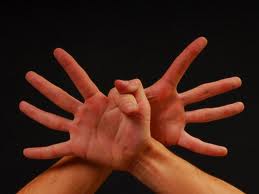
Hindu/Yoga Garuda Mudra

In terms of Deity interaction, the mudra works with the mantra to invoke the qualities and protection of Garuda.

In terms of Yoga , the Garuda Mudra activates the blood flow and the circulation. It also helps alleviate exhaustion.

  Clasp your thumbs and place your hands, the right on top of the left with the palms facing inwards, on your lower abdomen. Remain in this position for about ten breaths.

  Later slide your hands to the navel. Remain there for another ten breaths.

  Then place your hands on the pit of the stomach and remain for another ten breaths.

  After this, place your left hand on the sternum, turn your hands in the direction of your shoulders and spread your fingers.

Source: http://health.indianetzone.com/yoga/1/garuda_mudra_suchi_mudra.htm

Some sources have the hands the opposite way round, as shown here:


Buddhist Garuda Mudra

Pictorial Guide: http://vajrayogini.com/mudras/mudra018.html


This mudra is used to purify offerings and beings, and to protect against obstructions such as those form illness and spirits.  One example is its use prior to Kusali Tsog.

Garuda on Youtube

28 Friday Oct 2011

Posted by Mantrik in Garuda Images

≈ Leave a comment


Invoking Garuda

26 Wednesday Oct 2011

Posted by Mantrik in Garuda Images, Garuda Removing Obstructions

≈ 1 Comment

According to different cultures, the Garuda is invoked to drive away negative forces.

These negativities often relate to health, including warding off snakes, snake-bite, and all types of poisons having an animal, vegetable or mineral origin.Of course, disease is sometimes thought to be related to the activities of the Nagas, traditional enemies of Garudas.

Garuda is also a weather-deity sometimes depicted with a hammer representing thunder, for example.

There is a female Garuda known as a Garudi, but I know of no practices associated with them.

IN BUDDHISM

Garuda is regarded as a protective Deity.  Shakyamuni is reputed to have manifested as Garuda at the request of Vajrapani to pacify and overcome the harmful acitivites of malevolent Naga beings who were creating sicknesses.

Practices with which I am familiar combine Garuda’s qualities with those of the enormously  powerful deity, Vajrapani, who is the first to be praised and invoked.

There are different forms of Garuda, with colours representing aspects of Wisdom and characterisitics of the 5 Buddha Families:

Yellow Garuda (Earth), Black Garuda (Air),  Red Garuda (Fire), White Garuda (Water) and a Blue or Rainbow Garuda (Space).

Different parts of the Garuda’s body also represent aspects of Dharma, as well as the solar and lunar winds entering the central channel.

Forms of Garuda are sometimes strutting on the ground or flying, and may be zoomorphic combinations of man and Garuda (most commonly) or Garuda and Snow Lion for example, combining the qualites of each. There are also depictions where the snakes in his mouth have become garlands of jewels and the face then resembles Kirtimukha  – to me this may be blurred iconography or another combination of two beings.

So, I may invoke Garuda simply through making offerings, reciting his mantra ( OM PA KSHIM SVAHA)  and visualising a particular Garuda. Alternatively,  I may invoke a specialised form through a ritual.

(Source:  Robert Beer’s Encyclopedia of Tibetan Symbols and Motifs)

Note: Offerings to Garuda

In addition to offerings traditionally made to a Buddhist Tantric Deity, there was formerly a ‘red offering’ of flesh and blood to Garuda.  In Tibet, in both Bon and Nyingma historically regarded Garuda in some aspects as a ‘bdud’ demonic force to be propitiated with such an offering. This practice has now been abandoned although it is not known if isolated practices continue.

Amoghasiddhi

In the same way as Garuda is seen as the guardian and mount of Shiva, in the Vajrayana he is seen to have the ame relationship with Amoghasiddhi.  The shang-shang half-man half-bird is seen as representing man in transition towards a new level of consciousness.  (Lama Govinda).

RITUAL: Fire Sword of Black Garuda (for those with HYT empowerment only)

An example of this is the Fire Sword of Black Garuda which was relatively recently popular as a protection against the SARS outbreak. This description is of the process and omits the actual mantras etc.

The ceremony begins with Refuge and the generation of Bodhichitta. If performed for your own health it must be with a motivation of being healthy in order to serve others.

Offerings are then made to Garuda of the usual substances.

Praise then follows describing the power of the Garuda to shake even the galaxies and to destroy all spirit possession and other harmful obstructions above, amidst and below.   The pacifying mantra garland and all phenomena then blaze with the fire of purification, including all creatures, land and planets.

There is then recitation of mantras to further pacify obstructions, followed by a powerful wrathful mantra recitation with a visualisation of powerful beams of light emanating from Garuda into the bodies of those ill or suffering harm from spirits.

The person performing the ceremony visualises that they possess all the qualties of Black Garuda  – omniscient mind, realisations, perfect power, compasison etc.

(Note: for this purpose Garuda is regarded as a Buddha)

There then follows a Dedication and request that the practitioner may attain the enlightened state of Black Garuda and lead other beings to his enlightened state.

(Source document: FPMT Lama Zopa Rinpoche)

RITUAL: Vajrapani, Hayagriva and Garuda

(Meditation and Recitation of the Threefold Wrathful One)

Tantric Empowerment is required to perform this ritual.

This ritual invokes the powers of three deities in combination to purify all diseases, maicious inflictions, negativities and obscurations of the practitioner and others.  The practice may be performed for specific individuals.

There is self-generation as Vajrapani adorned with Hayagriva and Garuda.

The usual offerings, praises and requests are made and the ritual ends with Vajrasattva 100 syllable mantra as Purification, followed by Dedication related to Vajrapani Threefold Wrathful One. (It is important to regard the combined qualties of the deities as a single being.)

All the blessings and inspirations of all the Buddhas and Bodhisattvas are concentrated and directed as lights emanating from the mantra rosary to purify the practitioner and other beings.

The mantra is:  OM VAJRAPANI HAYAGRIVA GARUDA HUM PHAT.

(Source document: FPMT Sadhana)

GARUDA IN Highest Yoga Tantra

Garuda is invoked and the Garuda Mudra is performed to purify substances and provide protection for the practitioner during such offerings as Kusali Tsog.

Note: Offerings to Garuda

In addition to offerings traditionally made to a Buddhist Tantric Deity, there was formerly a ‘red offering’ of flesh and blood to Garuda.  In Tibet, in both Bon and Nyingma historically regarded Garuda in some aspects as a ‘bdud’ demonic force to be propitiated with such an offering. This practice has now been abandoned although it is not known if isolated practices continue.

IN HINDUISM

I know very little of Garuda as a deity who is invoked, but would assume that  his main role is in dealing with snakes and illnesses and as a thunder God. Unlike in Buddhism where the Garuda is at times regarded as a Buddha, in Hinduism he is a lesser deity.

Gallery

Images of Garuda

22 Saturday Oct 2011

Posted by Mantrik in Garuda Images

≈ Leave a comment

Newer posts →

Recent Posts

  • Journey to the West Research
  • Shamanic Phurba / Kila
  • Introduction to the Phurba / Kila
  • RED DZAO SHAMANISM
  • A Female Shaman’s Coat, with Garuda connections

Recent Comments

yogimicyahoocom's avataryogimicyahoocom on ANIMALS AND DEITIES
Mantrik's avatarMantrik Garudika on A Female Shaman’s Coat,…
Mantrik's avatarMantrik Garudika on Phurba, Kila and Vajrakil…
rikudousennin's avatarrikudousennin on Phurba, Kila and Vajrakil…
rikudousennin's avatarrikudousennin on A Female Shaman’s Coat,…

Archives

  • May 2018
  • July 2017
  • August 2016
  • June 2015
  • November 2014
  • October 2014
  • May 2014
  • November 2013
  • October 2013
  • July 2013
  • May 2013
  • February 2013
  • December 2012
  • November 2012
  • October 2012
  • September 2012
  • August 2012
  • May 2012
  • April 2012
  • March 2012
  • February 2012
  • January 2012
  • December 2011
  • November 2011
  • October 2011

Categories

  • Garuda Amulets
  • Garuda Images
  • Garuda in Buddhism
  • Garuda in Dzogchen
  • Garuda in Hinduism
  • Garuda in Other Religions
  • Garuda LInks
  • Garuda Purana Wisdom
  • Garuda Removing Obstructions
  • Ritual & Implements
  • Shamanism
  • Uncategorized

Meta

  • Create account
  • Log in
  • Entries feed
  • Comments feed
  • WordPress.com

Recent Posts

  • Journey to the West Research
  • Shamanic Phurba / Kila
  • Introduction to the Phurba / Kila
  • RED DZAO SHAMANISM
  • A Female Shaman’s Coat, with Garuda connections

Recent Comments

yogimicyahoocom's avataryogimicyahoocom on ANIMALS AND DEITIES
Mantrik's avatarMantrik Garudika on A Female Shaman’s Coat,…
Mantrik's avatarMantrik Garudika on Phurba, Kila and Vajrakil…
rikudousennin's avatarrikudousennin on Phurba, Kila and Vajrakil…
rikudousennin's avatarrikudousennin on A Female Shaman’s Coat,…

Archives

  • May 2018
  • July 2017
  • August 2016
  • June 2015
  • November 2014
  • October 2014
  • May 2014
  • November 2013
  • October 2013
  • July 2013
  • May 2013
  • February 2013
  • December 2012
  • November 2012
  • October 2012
  • September 2012
  • August 2012
  • May 2012
  • April 2012
  • March 2012
  • February 2012
  • January 2012
  • December 2011
  • November 2011
  • October 2011

Categories

  • Garuda Amulets
  • Garuda Images
  • Garuda in Buddhism
  • Garuda in Dzogchen
  • Garuda in Hinduism
  • Garuda in Other Religions
  • Garuda LInks
  • Garuda Purana Wisdom
  • Garuda Removing Obstructions
  • Ritual & Implements
  • Shamanism
  • Uncategorized

Meta

  • Create account
  • Log in
  • Entries feed
  • Comments feed
  • WordPress.com

Blog at WordPress.com.

Privacy & Cookies: This site uses cookies. By continuing to use this website, you agree to their use.
To find out more, including how to control cookies, see here: Cookie Policy
  • Subscribe Subscribed
    • Khyung Garuda ཁྲོཾ
    • Already have a WordPress.com account? Log in now.
    • Khyung Garuda ཁྲོཾ
    • Subscribe Subscribed
    • Sign up
    • Log in
    • Report this content
    • View site in Reader
    • Manage subscriptions
    • Collapse this bar
 

Loading Comments...