• Garuda Dandakam
  • Garuda Purana – wisdom teachings
  • Garuda Resources
  • Garuda Rituals

Khyung Garuda ཁྲོཾ

~ Garudapedia – for all things Garuda

Khyung Garuda ཁྲོཾ

Category Archives: Garuda Removing Obstructions

Garuda in Thailand – Paya Krut Mantra

30 Sunday Oct 2011

Posted by Mantrik in Garuda Amulets, Garuda in Buddhism, Garuda Removing Obstructions

≈ Leave a comment

The Thai name for Garuda is Paya Krut (sometimes seen as Krut Garuda).

Making offerings and chanting the mantra is believed to bring wordly success and wealth as well as spiritual protection.  I’ve shown a typical amulet pendant – there are more in the Garuda Images category.

The mantra is:

Karubija Gidti Mandtang Ma

A U Om Payaa Krut Ruj Ruj Laew Ruay


Na Dai Ngern Na Dai Tong Na Dai Sap

Na Mettaa Na Jaroen


Na Man Kong Na Laang Aathan Atitaami

Traditional Hindu Invocation of Garuda

29 Saturday Oct 2011

Posted by Mantrik in Garuda in Hinduism, Garuda Removing Obstructions

≈ Leave a comment

Garuda
 

vyAdhUta-kesara-saTA-vikarALavaktram
hastAgravisphurita-sha~NkhagadAsi-chakram |
AviShkR^itaM sapadi yena nR^isiMharUpam
nArAyaNaM tamapi vishvasR^ijaM namAmi ||

The mantras of garuDa, the vAhana of shrImannArAyaNa, are well known in the tantras. Though the upAsanA of gAruDa mantra is associated popularly with cure for snake bite or sarpabhaya nivR^itti, the mantra is used to procure various other benefits as well. gaRuDa is worshipped with different mantras in different forms such as mahAgaruDa, AshugaruDa, sarpAshana garuDa, prachaNDa garuDa, mAyA garuDa, sammohana garuDa, jvAlAmAlin, kUTagAruDa etc.

Some of the fruits ascribed to garuDopAsanA are:

dR^iShTaprayogabahuLaM dR^iShTAdR^iShTArthasAdhakam |
AkaraM sarvasiddhInAM divyaM paramagAruDam ||
AyurArogyavijayadhanadhAnyasamR^iddhidam |
putradaM vAkpradaM nR^INAM sarvasaubhAgyavardhanam ||
rAjavashyaM lokavashyaM shtrIpuMvashyaM tathaiva cha |
sarvarakShAkaraM puMsAM sarvashatrunibarhaNam ||
yuddhe tu vijayaM rAjA prApnuyAdyuddhadurmadaH |
sarvavyAdhiprashamanaM sarvama~Ngalama~Ngalam ||
saptakShudrakaraM mantraM saptakShudraharaM tathA |
kR^ityAshUnyakaraM chaiva kR^ityAshUnyaharaM tathA ||
shAntikaM paushTikaM chaiva aShTaishvaryakaraM param |
bahunA.tra kimuktena chaturvargaphalapradam ||

The primary application of the mantra is in the removal of different kinds of poison such as sthAvara, ja~Ngama, kR^itrima, sahaja, sha~NkA and hAlAhala. The upAsanA of the various garuDa mantras also bless the upAsaka with miraculous powers, mastery over snakes, health, wealth, success, prosperity, progeny, speech, victory in wars, freedom from enemies etc. The use of garuDa mantra in vashya, AkarShaNa, stambhana, mohana, ucChATana, mAraNa and unmAdana [kShudrasaptaka] are also described in the shAstras. The mantra is used for both abhichAra and pratyabhiChara. Similarly, gAruDa kR^ityA is of great might and can be used for offence or defense.

For laukika and AbhichArika prayogas, garuDa is visualized independently, with his shakti [lakShmIH, kIrtiH, jayA, mAyA] or attendants [suparNa, tArkShya, vainateya, bhIma], sporting various weapons. However, for protection or sAtvikopAsanA, garuDa is always visualized carrying shrImannArAyaNa. gAruDa mantras are classified into four types: bIja, piNDa, saMj~nA and pada and their use is based on the purpose of upAsanA. Pada mantra described in dakShiNAmUrti samhitA as also the pa~nchAkSharI mantra are popular among shrIvidyA upAsakas. In shrIkrama tantra, amR^ita garuDa is an a~Nga of dhanvantari, who in turn is the a~Nga of vAsudeva represented by the 12 syllabled mantra. The stuti mantra, which is technically a mAlA mantra, is used to offer puShpA~njali to garuDa.

The garuDa maNDala involves the worship of nine gAruDa mUrtis with their respective mantras. mahAgaruDa is stationed at the center of the maNDala surrounded by the eight mUrtis in the eight cardinal directions. mahAgaruDa is described as suvarNAbha [of golden complexion] below the knees, himaprabha [of white complexion] from waist below, ku~NkumAruNa [red like the rising sun] from neck and below and clear like the quartz above the neck. His left and right feet respectively exhibit the ku~nchita and svastika postures. His feet touch the pAtALa and head extends beyond the brahma loka. His nose is long, blue in color and terrifying whereas the ears are charming and decorated with mANikya kuNDalas. His face, shining with three eyes, is fierce due to the protruding sharp teeth. His eyes are tawny reddish in color [kapila varNa] and he is adorned with the best of ornaments. His hands are long and shoulders are gigantic. The nine great serpents form his ornaments. He wears ananta and guLika as bracelets in his two hands, vAsuki as the yaj~nasUtra, takShaka as the waist band, kArkoTaka as the necklace, padma and mahApadma as ear ornaments and sha~Nkha as the headgear. He is seated on a lotus and sports wings that extend infinitely in either direction. He shines with eight hands in which he holds sha~Nkha, chakra, sudhAkumbha, nAga, muShTi, gadA and khaDga. Two of his hands are engaged on serving the lotus feet of shrImannArAyaNa seated on his back, along with bhagavatI ramA. The garuDa pa~nchAkSharI kalpa from kAshyapa samhitA and garuDa kalpa of AkAshabhairava tantra deal extensively with the upAsanA of pakShirAja.

Aku~nchya sarvamaparaM pravisArya pAdam
tirya~NmukhaM chaTulachakravivR^ittasha~Nkham |
anyonyaghaTTitakaraM lalashabdayukta-
muDDIyamAnamanishaM smara duHkhashAntyai ||


Source: http://www.kamakotimandali.com/misc/garuda.html

Garuda Mudras

28 Friday Oct 2011

Posted by Mantrik in Garuda Images, Garuda in Buddhism, Garuda in Hinduism, Garuda Removing Obstructions

≈ Leave a comment

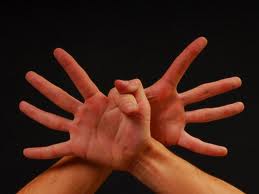
Hindu/Yoga Garuda Mudra

In terms of Deity interaction, the mudra works with the mantra to invoke the qualities and protection of Garuda.

In terms of Yoga , the Garuda Mudra activates the blood flow and the circulation. It also helps alleviate exhaustion.

  Clasp your thumbs and place your hands, the right on top of the left with the palms facing inwards, on your lower abdomen. Remain in this position for about ten breaths.

  Later slide your hands to the navel. Remain there for another ten breaths.

  Then place your hands on the pit of the stomach and remain for another ten breaths.

  After this, place your left hand on the sternum, turn your hands in the direction of your shoulders and spread your fingers.

Source: http://health.indianetzone.com/yoga/1/garuda_mudra_suchi_mudra.htm

Some sources have the hands the opposite way round, as shown here:


Buddhist Garuda Mudra

Pictorial Guide: http://vajrayogini.com/mudras/mudra018.html


This mudra is used to purify offerings and beings, and to protect against obstructions such as those form illness and spirits.  One example is its use prior to Kusali Tsog.

Invoking Garuda

26 Wednesday Oct 2011

Posted by Mantrik in Garuda Images, Garuda Removing Obstructions

≈ 1 Comment

According to different cultures, the Garuda is invoked to drive away negative forces.

These negativities often relate to health, including warding off snakes, snake-bite, and all types of poisons having an animal, vegetable or mineral origin.Of course, disease is sometimes thought to be related to the activities of the Nagas, traditional enemies of Garudas.

Garuda is also a weather-deity sometimes depicted with a hammer representing thunder, for example.

There is a female Garuda known as a Garudi, but I know of no practices associated with them.

IN BUDDHISM

Garuda is regarded as a protective Deity.  Shakyamuni is reputed to have manifested as Garuda at the request of Vajrapani to pacify and overcome the harmful acitivites of malevolent Naga beings who were creating sicknesses.

Practices with which I am familiar combine Garuda’s qualities with those of the enormously  powerful deity, Vajrapani, who is the first to be praised and invoked.

There are different forms of Garuda, with colours representing aspects of Wisdom and characterisitics of the 5 Buddha Families:

Yellow Garuda (Earth), Black Garuda (Air),  Red Garuda (Fire), White Garuda (Water) and a Blue or Rainbow Garuda (Space).

Different parts of the Garuda’s body also represent aspects of Dharma, as well as the solar and lunar winds entering the central channel.

Forms of Garuda are sometimes strutting on the ground or flying, and may be zoomorphic combinations of man and Garuda (most commonly) or Garuda and Snow Lion for example, combining the qualites of each. There are also depictions where the snakes in his mouth have become garlands of jewels and the face then resembles Kirtimukha  – to me this may be blurred iconography or another combination of two beings.

So, I may invoke Garuda simply through making offerings, reciting his mantra ( OM PA KSHIM SVAHA)  and visualising a particular Garuda. Alternatively,  I may invoke a specialised form through a ritual.

(Source:  Robert Beer’s Encyclopedia of Tibetan Symbols and Motifs)

Note: Offerings to Garuda

In addition to offerings traditionally made to a Buddhist Tantric Deity, there was formerly a ‘red offering’ of flesh and blood to Garuda.  In Tibet, in both Bon and Nyingma historically regarded Garuda in some aspects as a ‘bdud’ demonic force to be propitiated with such an offering. This practice has now been abandoned although it is not known if isolated practices continue.

Amoghasiddhi

In the same way as Garuda is seen as the guardian and mount of Shiva, in the Vajrayana he is seen to have the ame relationship with Amoghasiddhi.  The shang-shang half-man half-bird is seen as representing man in transition towards a new level of consciousness.  (Lama Govinda).

RITUAL: Fire Sword of Black Garuda (for those with HYT empowerment only)

An example of this is the Fire Sword of Black Garuda which was relatively recently popular as a protection against the SARS outbreak. This description is of the process and omits the actual mantras etc.

The ceremony begins with Refuge and the generation of Bodhichitta. If performed for your own health it must be with a motivation of being healthy in order to serve others.

Offerings are then made to Garuda of the usual substances.

Praise then follows describing the power of the Garuda to shake even the galaxies and to destroy all spirit possession and other harmful obstructions above, amidst and below.   The pacifying mantra garland and all phenomena then blaze with the fire of purification, including all creatures, land and planets.

There is then recitation of mantras to further pacify obstructions, followed by a powerful wrathful mantra recitation with a visualisation of powerful beams of light emanating from Garuda into the bodies of those ill or suffering harm from spirits.

The person performing the ceremony visualises that they possess all the qualties of Black Garuda  – omniscient mind, realisations, perfect power, compasison etc.

(Note: for this purpose Garuda is regarded as a Buddha)

There then follows a Dedication and request that the practitioner may attain the enlightened state of Black Garuda and lead other beings to his enlightened state.

(Source document: FPMT Lama Zopa Rinpoche)

RITUAL: Vajrapani, Hayagriva and Garuda

(Meditation and Recitation of the Threefold Wrathful One)

Tantric Empowerment is required to perform this ritual.

This ritual invokes the powers of three deities in combination to purify all diseases, maicious inflictions, negativities and obscurations of the practitioner and others.  The practice may be performed for specific individuals.

There is self-generation as Vajrapani adorned with Hayagriva and Garuda.

The usual offerings, praises and requests are made and the ritual ends with Vajrasattva 100 syllable mantra as Purification, followed by Dedication related to Vajrapani Threefold Wrathful One. (It is important to regard the combined qualties of the deities as a single being.)

All the blessings and inspirations of all the Buddhas and Bodhisattvas are concentrated and directed as lights emanating from the mantra rosary to purify the practitioner and other beings.

The mantra is:  OM VAJRAPANI HAYAGRIVA GARUDA HUM PHAT.

(Source document: FPMT Sadhana)

GARUDA IN Highest Yoga Tantra

Garuda is invoked and the Garuda Mudra is performed to purify substances and provide protection for the practitioner during such offerings as Kusali Tsog.

Note: Offerings to Garuda

In addition to offerings traditionally made to a Buddhist Tantric Deity, there was formerly a ‘red offering’ of flesh and blood to Garuda.  In Tibet, in both Bon and Nyingma historically regarded Garuda in some aspects as a ‘bdud’ demonic force to be propitiated with such an offering. This practice has now been abandoned although it is not known if isolated practices continue.

IN HINDUISM

I know very little of Garuda as a deity who is invoked, but would assume that  his main role is in dealing with snakes and illnesses and as a thunder God. Unlike in Buddhism where the Garuda is at times regarded as a Buddha, in Hinduism he is a lesser deity.

Garuda as a Dharmapala (Dharma Protector)

23 Sunday Oct 2011

Posted by Mantrik in Garuda Removing Obstructions

≈ 2 Comments

I am seeking any information about Garuda and his forms as a Dharmapala.

He is depicted as the ‘mount’ of deities in Buddhism as well, such as Amoghasiddhi, but there are mentions of Garuda as a Dharmapala in his own right which I’m trying to recall! 😉

So far, I am familair mainly with his power used in combination as the Threefold Wrathful One of Vajrapani, Hayagriva and Garuda.  He is also sometimes considered as a form of Vajrapani, as stated here:

http://www.wisdomlib.org/buddhism/book/the-gods-of-northern-buddhism/d/doc4713.html

”Vajrapani is the second Dhyani-Bodhisattva corresponding to the five Celestial Jinas. He is also one of the group of eight Dhyani-Bodhisattva found in the Northern Buddhist temples, in which case he is represented standing, with the vajra and ghanta supported by lotus-flowers, the stems of which he holds in his hands in ‘charity’ and ‘argument’ mudra.

He has several ferocious (Dharmapala) forms, assumed to combat the various demons.

The most important of these forms are:

Vajrapani-Acdrya (Dharmapala).

He is represented in human form, with his dishevelled hair standing on end and wearing a skull crown. His expression is angry, and he has the third eye. Around his neck is a serpent necklace, and at his waist a belt of heads, underneath which is a tiger skin. He steps to the right, and in his uplifted hand is a vajra. If painted, he is dark blue, and is generally surrounded by flames in which are small Garudas.

Nilambara-Vajrapani (Yi-dam).

He has one head, a third eye, a skull crown, with sometimes a vajra, and snake in his dishevelled hair, and has four or six arms. Two hands are held at his breast in a mystic mudra, and the second right arm is uplifted holding the vajra. He steps to the right on a crowned personage 13 lying on a bed of serpents.

Acala-Vajrapani (Dharmapala).

He has four heads, four arms as well as four legs, and his symbols are vajra, sword, lasso, and skull-cup (kapala). He treads on demons.

Mahacakra-Vajrapani (Yi-dam).

He has three heads with the third eye, six arms, and two legs. He is painted blue — the head at the right is white, at the left red. His symbols are the vajra and a long serpent, and he holds his yum with the two original arms. The sakti holds a kapala (skull-cup) and grigug (chopper). He steps to the right on Brahma and his left foot treads on Siva.

Garuda form.

He is usually standing and has the wings and claws of a Garuda (PI. lix, fig. c). He may have a human head with a beak, or a head like a Garuda. He sometimes carries a sword and a gourd-shaped bottle, or his two hands may be in ‘ prayer mudra. ”

This form is complicated in that in some legends Vajrapani protects the rain-giving Nagas from the Garudas by assuming the form of a Garuda and leading them away from harming the Nagas.

In all of the forms the Garuda represents a powerful force of Wisdom protecting against inner, outer and secret obstacles.

If anyone has a source describing Garuda as a Dharmapala I would welcome the information. 🙂

Newer posts →

Recent Posts

  • Journey to the West Research
  • Shamanic Phurba / Kila
  • Introduction to the Phurba / Kila
  • RED DZAO SHAMANISM
  • A Female Shaman’s Coat, with Garuda connections

Recent Comments

yogimicyahoocom's avataryogimicyahoocom on ANIMALS AND DEITIES
Mantrik's avatarMantrik Garudika on A Female Shaman’s Coat,…
Mantrik's avatarMantrik Garudika on Phurba, Kila and Vajrakil…
rikudousennin's avatarrikudousennin on Phurba, Kila and Vajrakil…
rikudousennin's avatarrikudousennin on A Female Shaman’s Coat,…

Archives

  • May 2018
  • July 2017
  • August 2016
  • June 2015
  • November 2014
  • October 2014
  • May 2014
  • November 2013
  • October 2013
  • July 2013
  • May 2013
  • February 2013
  • December 2012
  • November 2012
  • October 2012
  • September 2012
  • August 2012
  • May 2012
  • April 2012
  • March 2012
  • February 2012
  • January 2012
  • December 2011
  • November 2011
  • October 2011

Categories

  • Garuda Amulets
  • Garuda Images
  • Garuda in Buddhism
  • Garuda in Dzogchen
  • Garuda in Hinduism
  • Garuda in Other Religions
  • Garuda LInks
  • Garuda Purana Wisdom
  • Garuda Removing Obstructions
  • Ritual & Implements
  • Shamanism
  • Uncategorized

Meta

  • Create account
  • Log in
  • Entries feed
  • Comments feed
  • WordPress.com

Recent Posts

  • Journey to the West Research
  • Shamanic Phurba / Kila
  • Introduction to the Phurba / Kila
  • RED DZAO SHAMANISM
  • A Female Shaman’s Coat, with Garuda connections

Recent Comments

yogimicyahoocom's avataryogimicyahoocom on ANIMALS AND DEITIES
Mantrik's avatarMantrik Garudika on A Female Shaman’s Coat,…
Mantrik's avatarMantrik Garudika on Phurba, Kila and Vajrakil…
rikudousennin's avatarrikudousennin on Phurba, Kila and Vajrakil…
rikudousennin's avatarrikudousennin on A Female Shaman’s Coat,…

Archives

  • May 2018
  • July 2017
  • August 2016
  • June 2015
  • November 2014
  • October 2014
  • May 2014
  • November 2013
  • October 2013
  • July 2013
  • May 2013
  • February 2013
  • December 2012
  • November 2012
  • October 2012
  • September 2012
  • August 2012
  • May 2012
  • April 2012
  • March 2012
  • February 2012
  • January 2012
  • December 2011
  • November 2011
  • October 2011

Categories

  • Garuda Amulets
  • Garuda Images
  • Garuda in Buddhism
  • Garuda in Dzogchen
  • Garuda in Hinduism
  • Garuda in Other Religions
  • Garuda LInks
  • Garuda Purana Wisdom
  • Garuda Removing Obstructions
  • Ritual & Implements
  • Shamanism
  • Uncategorized

Meta

  • Create account
  • Log in
  • Entries feed
  • Comments feed
  • WordPress.com

Create a free website or blog at WordPress.com.

Privacy & Cookies: This site uses cookies. By continuing to use this website, you agree to their use.
To find out more, including how to control cookies, see here: Cookie Policy
  • Subscribe Subscribed
    • Khyung Garuda ཁྲོཾ
    • Already have a WordPress.com account? Log in now.
    • Khyung Garuda ཁྲོཾ
    • Subscribe Subscribed
    • Sign up
    • Log in
    • Report this content
    • View site in Reader
    • Manage subscriptions
    • Collapse this bar