Two new metal masks for my collection. A little repainting needed. 🙂


14 Wednesday Mar 2012
Posted in Garuda Amulets, Garuda in Buddhism, Garuda in Hinduism
Two new metal masks for my collection. A little repainting needed. 🙂
06 Tuesday Mar 2012
Posted in Garuda Amulets
MALAS – PRAYER BEADS
Buddhist malas are used at a basic level for counting mantras, but the materials used and the number of beads have acquired meanings as their use has evolved. There is a nice book entitled ‘Beads of Faith’ (authors Henry & Marriott) which charts the use of rosaries across all faiths, and of course our own Robert Beer who offers some insight into Tibetan usage:
I am not at all shy to admit that the Buddhist mala derived from the Hindu ‘japa mala’ and that the meanings ascribed to 108 beads have been adapted for our needs. There are also superstitions – use only the left hand, the ring finger or the index finger and thumb. (A Hindu would be horrified – they use the right hand as the left is used for ‘toilet’ functions.)
Most monks I have spoken to (mainly Tibetan) have a simple wooden or seed mala with no markers or decoration, and advise that either hand will do and the superstition of not crossing the guru bead is not important. 108 beads mean that we have 100 plus 8 to account for mistakes. Tibetans also use their mala for blessing others, as it is believed the mala absorbs great power through deity mantra practice. I’ve also heard that in a monastery if a monk becomes arrogant, the others will rub their malas into his head. LOL 🙂
Some, I believe, have a ‘public’ mala, but use another in private for Tantra, when the numbers and usage become much more complex and meaningful than originally indicated by the monks.
They will cover a mala when in use for mantra recitation.
Maybe this is a cultural habit from India. Hindu monk will use the mala inside a mala bag when in public, which prevents others seeing it – there is quite an emphasis on seeing as the principal way of engaging with a deity and the ‘evil eye’ is prevented from affecting a hidden mala.
I have tried several different materials because I felt ‘drawn to them’. Fancy lapis with heavy carved gemstone dorje dangling and tinkling as a bell, huge seed malas which would be more at home around the neck of a Saddhu (or 2), and weird materials such as fossil coral.
Some practitioners use Lapis for Medicine Buddha, Carnelian for Vajrayogini, Bone for wrathful practices etc. – a different one for each deity. The colour of the deity is matched by the gemstone, in general.
Others believe that as the mala may be part of an ‘offering’ (for example as part of a mandala) they should be of the best material we can afford.
With many hundreds of thousands of mantras to count, in the end simple and lightweight seems best, so I have strung a few of my own using small bodhiseed, green sandalwood (scented), and ebony – with gemstone markers. I have found doubled -up nylon thread is best, sometimes with a single very thin fishing monofilament as a backup in case of breakage, with knots superglued, and with a stainless steel ring at the bottom, instead of a tassel, for me to attach whatever I want. I have one bodhiseed mala which shows little sign of wear after several hundred thousand recitations.
I have give away many malas as I have experimented and have no ‘attachment’ to them, but find the use of them interesting.
The method of blessing I have been taught involves placing the mala in the right palm, placing the left hand on top (so cupping the mala) silently reciting the Yidam’s mantra 3 or 7 times and then blowing on the mala 3 times. When finished with, the same is done.
I oil wooden or seed malas (patchouli and lavender) but not gemstones. Some gemstones are quite fragile; lapis, for example, can be harmed by sweat and water, so is not a good one to wear all the time. If there is a risk of dampness (of any sort) I keep gemstone malas in a waterproof pouch on my belt or in my pocket. Some oils may have chemicals which affect gemstones, but I’m not sure. I do spray any new wood or seed mala with fabric waterproofer to protect the string and bead, then oil afterwards.
There is a special demand for bone malas made from the skulls of dead monks. I believe there to be a lot of fake malas of this type on the net. The Chinese (including Hong Kong) also may call any blue mala ‘lapis’, for example, and pretend they are unaware that it is a specific material. There are also many fake gemstones in use. Gems described as ‘moonstone’ may in fact be opalite (glass), and most dzi beads are the result of laboratory chemistry and cookery rather than nature. Caveat emptor. 😉
Methods of stringing vary as well. Three strands (or another significant number) tends to be recommended in Tibetan malas, but most I’ve seen are on a bit of rough waxed string, maybe some made from Yak wool or simply cotton. In India malas tend to be knotted between the beads (a Hindu preference for beads not to touch each other). In China, the trend seems to be a single piece of strong thread.
There is a practical consideration. In group work the sound of gemstones clicking may be distracting. Easily resolved – use a wooden or seed mala, or string the gemstone mala so that it may be tightened a little to avoid noise, or knot between adjacent beads.
When dealing with Bodhiseed or bone, 5 or 9 threads is possible, especially if twisted into one string and waxed beforehand, as the holes drilled in the beads tend to be large. With gemstones I rarely find the holes large enough to take more than 3.
Some shapes are easier to use than others I find. Doughnut shaped beads (say 8×6 mm) are easy to move and allow the mala to be shorter than if using round beads (of say 8mm). This means a full mala can be easily kept off the ground during prostrations or when seated on the floor.
Aside from the various meanings ascribed to the beads and threads, practical considerations are also important. I’ve found (no surprise) that good quality costs more and that good maintenance (restringing, cleaning, oiling) is very important. But even more important is its place in the relationship with the guru, who may have given the mala to you or blessed it, and that can be priceless.
Apparently they are also used in Zen and in the Theravada:
http://dic.academic.ru/dic.nsf/enwiki/754783
quoted by Gyatrul Rinpoche in “The Generation Stage in Buddhist Tantra ” :
Padmasambhava, says: “The best type of mala to use to increase the number of recitations is a mala made from some type of precious jewel (Tib. Tin O che). A mediocre type of mala is made from the seed of a tree or fruit, and inferior type of mala is made from wood, earth, stone or medicine.”
A mala made from seashells, earth, wood or seeds from trees or fruit is meant to be used to accomplish peaceful sadhanas and peaceful action. A mala made from gold will accomplish expansive karmas. A red coral mala is best for accomplishing powerful sadhanas. A steel or turquoise mala is good for wrathful activity. A mala made from dzi or other precious stones can be used to accomplish any of the karmic activities you are doing.
A mala made from apricot stones will accomplish expansive activity. A mala made from “lot ton” (a tiny, round black seed within a fruit) accomplishes powerful activity A mala made from raksha beads accomplishes wrathful practices. A mala made from bodhi seeds accomplishes all dharmas. Malas of bodhi tree wood accomplish peaceful karmas. A mala of mulberry beads accomplishes powerful karmas. Malas of mahogany wood accomplish wrathful practices. Malas made of ivory, especially from an elephant’s tusk, will accomplish all concerned activity.
Beads made of stone are good for expansive practice. Beads made of medicine are good for wrathful practice. Malas with many different types of jewels are good for any practice. However, I suggest that you not attempt to create a mala with a lot of different beads on it because, unless you know which combinations are effective, you may cause a non-positive result.
Next, the text mentions the different kinds of benefits that are derived from using different types of malas. An iron or steel mala multiplies the virtue that is accumulated with each recitation in a general way. A copper mala multiplies each recitation four times. A raksha mala multiplies each recitation by 20 million, and a pearl mala by 100 million. A silver mala multiplies by 100,000 and a ruby mala by 100 million. A bodhi seed mala manifests limitless benefits for any form of practice, be it peaceful, expansive, powerful or wrathful.
You should all know the mala’s meaning and the best way to string it. String your mala using three, five or nine strings, and no other number. Three strings symbolize the three kayas, five strings symbolize the five buddhas, and the nine strings symbolize the nine vehicles.
The main guru bead may be composed of three beads, symbolizing the three vajra states of being, the three kayas. The smallest bead on the outside should be blue, perhaps made of lapis. The color blue symbolizes the unchanging mind of ultimate truth. The bead in the middle should be red, to symbolize vajra speech, and the innermost bead should be white, to symbolize the vajra body.
Your mala must be blessed by a lama, and you should constantly bless your mala yourself by imbuing it with energy. You must put energy into your mala before counting recitations with it, to produce real benefit.
You should clean your mouth and hand, and then your mala, before using it. You may also scent it with sandalwood oil.
Next, generate yourself as the deity, place the mala in your left hand and arrange the beads with the guru bead placed vertically in the center. Recite the mantra that transforms all dharmas into the awareness of their true nature: OM SWABAVA SHUDDO SARVA DHARMA SWABAVA SHUDDO HAM. This mantra cleanses and transforms impure perceptions into the awareness of emptiness.
From emptiness, the guru bead appears as the central deity in the mandala, and the other beads appear as the members of the entourage. This part of the practice is the meditation upon the samayasattva. Next, invoke the jnanasattva. Invite the primordial wisdom beings to come forth, hooking them so that they dissolve into the samayasattva, just as you would in a sadhana. Invite the wisdom beings to come from their pure lands into the space in front of you. They then dissolve into your mala and remain firm there. Thus, every part of your mala is the entire mandala. This includes the central deity, entourage, lotus seats, ornaments, hand emblems, colors, etc. Blessing your mala in this way multiplies each syllable of whatever mantra you then recite 100,000 times, besides causing good karmic results. Therefore, it is extremely important to do this.
Your mala represents not only the form of the deity but the speech of the deity as well. For example, if you recite the One-HundredSyllable mantra, the guru bead represents the syllable OM and the other beads represent the remaining syllables.
Guru Padmasambhava said, “Whenever you recite peaceful mantras, use the tip of your thumb to count the mala. When reciting expansive mantras, use the third finger. Use the ring finger and thumb when reciting powerful mantras, and use the little finger when reciting wrathful mantras.” Use only your left hand to count mantras. The right hand is but rarely used; for instance, in some wrathful practices. Some books teach the use of both hands, but do not use the right hand only.
Whatever kind of practice you are doing, whether peaceful, wrathful, powerful or expansive, always be aware that the thumb is a vajra hook which hooks spiritual powers, deities and other blessings. It is also easy to move the beads with your thumb.
The text does not elaborate, but there are some extensive teachings on how to move the beads on the malas when performing certain practices. In some wrathful practices, you jerk the beads with both hands and so forth. If your mala has been repeatedly blessed by great lamas, by your own teacher and by yourself as part of your deity practice, it should accompany you like your shadow. You keep the root samaya of the vajra mala by never letting it leave your body.
04 Sunday Mar 2012
Posted in Garuda LInks
I have received this message today:
”Hi, my name is Uthayakumar, I am glad I found you. My page http://www.facebook.com/MightyGaruda is also dedicated to Garuda worship. Hope to hear from you.”
Please visit and ‘like’ this page and help support it. Thanks. 🙂
10 Friday Feb 2012
Posted in Garuda Amulets, Garuda Images
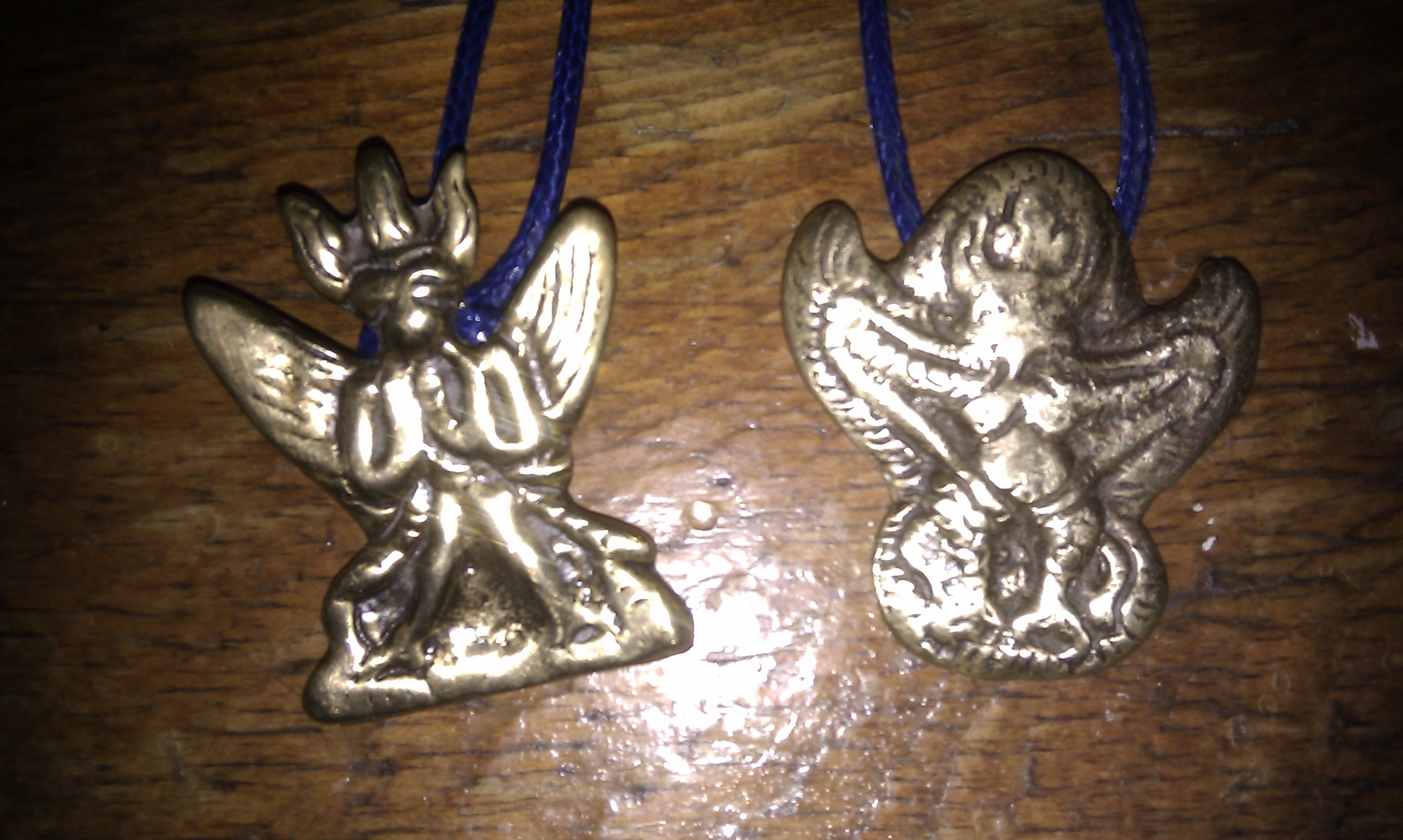
I sometimes wonder, when I see Garuda amulets, if Christian images of demons may have been based on ancient iconography from other cultures. Looking at these two, it’s not hard to see the similarity between Garuda and satanic images of devils:
29 Sunday Jan 2012
Posted in Garuda Purana Wisdom, Uncategorized
Peter Leiberson has composed music inspired by the Red Garuda. He explains:
The idea behind my second piano concerto was inspired by the Eastern mythological creature called the Red Garuda. The Red Garuda is a large bird that travels continuously — it never stops flying, and never needs to measure its flight or its distance. In mythology the Garuda represents the personal principle of not having to restrict how far one can travel or go in life’s journey. It symbolizes an absolute freedom, if you will, and its flight is not dependent on conventional limitations.
http://www.schirmer.com/default.aspx?TabId=2420&State_2874=2&workId_2874=30227
29 Sunday Jan 2012
Posted in Garuda Images, Garuda in Buddhism
Here we see Red Garuda above the head of the Jonang Master, Kunchen Dolpopa.
The Red Garuda is usually emblematic of fire, so the reference may be to the blazing of the fire of enlightenment, or a reference to Garuda’s protective qualites.

Kunchen Dolpopa was the first Jonang master to extensively teach Zhentong. In his most famous work, Mountain Dharma: An Ocean of Definitive Meaning (ri chos nges don rgya mtsho), Kunchen Dolpopa clarified the Zhentong view. These are referred to as the teachings of the “Heart’s Essence” (snying po’i don). As Kunchen Dolpopa’s Mountain Dharma and other Jonang texts were banned in the 17th century, they became extremely rare. In the 1970s and 1980s a few of these texts were re-discovered and re-printed, notably through the agency of His Holiness Dilgo Khyentse Rinpoche.
From the same source:
”The Red Garuda’s Cry to the Kalkins of Shambala”
Imperial Drala[1] of all dralas, Kalki Lord of Life,
you are primordial existence.
You hold in your left hand the crystal mirror,
the living storehouse consciousness of all. ki
Imperial Drala of all dralas, Kalki Lord of Life,
you are primordial aspiration.
In your right hand you brandish a crystal sword,
the inner nature of the seventh defiled consciousness. so
Imperial Drala of all dralas, Kalki Lord of Life,
you are primordial power.
You wear the blazing golden armor of life
and the snow-white pennants on your helmet flutter in the wind.
You are the life of the six sense consciousnesses. a la la
Descend now on the swirling divine thread
that rises from our offering of longing.
Now with your shining blade,
slash like lightning through clouds of confused desires, doubts and calculation,
that distort and veil the splendor of your pure domain.
Riding on the great horse of moving wind itself,
releasing and binding the elements and space
with your firm command, like the roar of thunder,
show the fearless tiger of the living seas,
the all-conquering lion of the living wind,
the deathless eagle of the living fire,
and the sovereign dragon of the living earth.
Show the true realm and the righteous rule of Shambala!
Pure, real, undeluded, and uncontrived newness.
Show the true realm and the righteous rule of Shambala,
that is the intrinsic life force of all beings.
Swiftly, swiftly, please do this now!
ki ki so so ashe lha gyel lo tak seng khyung druk di yar kye (x3)
O Kalki Lord, in this faithless time,
please remain with us and do not depart.
Remain here, moving on the pathways of virtue.
Remain here, resting on the raging flames of existence.
Remain here, sustained by the flesh and blood of men and beasts.
Remain here, subduing the fears and delusions of all realms.
Remain here as our only sovereign and law.
Please remain by day and night
and sing to us in waking and in dreams.
om ah hum ho ham ksha
[1] Drala: Tibetan: dra, enemy or opponent, and la, above; above the enemy; unconditioned wisdom and power beyond dualism; beyond opposites.
ADDITIONAL RED GARUDA MANTRAS:
hum tro ta ya ghar ru na
tri trom
ha ra nye lo yo so thun tu
om tat-purushaya vidhmahe
suvarna pakshaya dhimahi
tanno garuda prachodayat om
This wonderful image and texts were kindly supplied by Tashi Nyima.
Learn more here: http://greatmiddleway.wordpress.com/about/
27 Friday Jan 2012
Posted in Garuda in Buddhism, Garuda in Hinduism, Garuda LInks
I am delighted that Michael Slouber has been in contact with me and informed me of his wonderful website on Garuda Medicine:
Michael, already a distinguished lecturer and author, is completing a PhD thesis on the subject and the information on his website alone is simply astounding, applying academic rigour and real enthusiasm to the subject.
We share to conviction that Garuda is a deity who deserves to be elevated in terms of the perception of importance to both Hindu and Buddhist practice.
I look forward to the thesis and the book which I hope will follow, which must surely be the primary source of information about Garuda.
How wonderful!
04 Wednesday Jan 2012
Transcendental Wisdom Multi-Coloured Garuda Sadhana
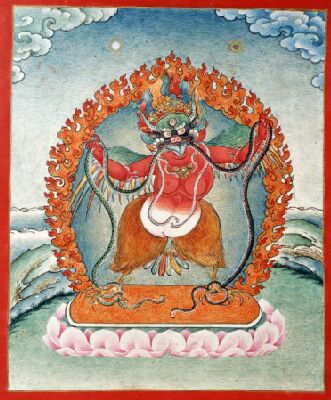

As with other Garuda Sadhanas, this one deals with defilements, illnesses and harm from spirits.
Garuda reduces his size to that of Mount Meru in order to be accessible for this practice.
I begin with Prostrations to the supreme deity Transcendental Wisdom Multi-Coloured Garuda, followed by Refuge in the Triple Gem.
Then there is Meditation on the Four Immeasurable Thoughts:
Equanimity, Loving Kindness, Compassion and Joyfulness.
After generating Special Bodhichitta to become Transcendental Wisdom Multi-Coloured Garuda for the sake of all beings, I begin the core practice. As with other sadhanas, you are advised not to self-generate as Transcendental Wisdom Multi-Coloured Garuda without the specific empowerment or HYT empowerment – simply perform the sadhana with Transcendental Wisdom Multi-Coloured Garuda in front.
From Emptiness, a seed syllable appears and transforms into the Naga King as a golden serpent, with my mind appearing above it as another seed syllable.
Light rays from this seed syllable radiate and pacify all sicknesses, spirit harm, negativities and obscurations which may harm me.
There then follows a detailed description of the self-generation and the forms of Buddha Garuda (white, at my throat), Jewel Garuda (gold, south), Lotus Garuda (red, west ), Karma Garuda (green, north) and Vajra Garuda (blue, east).
The seed syllables are then visualised in my body and Guru Vajrapani is invoked, taking a position at the crown of my head. All the Buddhas and Bodhisattvas merge into Vajrapani.
Offerings are then made to Guru Vajrapani, who then merges into me as the embodiment of the Refuges, and is asked for blessings.
I then become Transcendental Wisdom Multi-Coloured Garuda Vajrapani embodying all the 5 Buddha races/families , all the Buddhas and Bodhisattvas. I ask the deity for blessing.
With the syllables clearly appearing at my heart I recite the Garuda Mantra as many times as possible:
OM PA KSHI SVA HA
(sometimes expressed as OM PA KSHIM SVAHA).
Finally there is a Dedication.
The full sadhana is available from:
http://shop.fpmt.org/Garuda-Multi-colored-Sadhana-of-Transcendental-Wisdom-bkltlttr_p_1039.html
Image courtesy from: http://imageserver.himalayanart.org/fif=fpx/74219.fpx&obj=uv,1.0&page=image.html&rect=0,0,1,1&hei=400
21 Wednesday Dec 2011
Posted in Garuda Images, Garuda in Other Religions, Garuda LInks
I am reproducing images from himalayanart.org, a wonderful site full of images and information. I have included their copyright information at the foot of this post, and am making use of their images strictly for educational non-profit purposes.
Firstly, an overview of the Bon Deities. The full chart may be seen on the original website, and each deity has a link to further information. Khyung (the Garuda Eagle) is classed as a Wrathful Deity:
http://www.himalayanart.org/pages/Bon_Deities/index.html

First Image:
http://www.himalayanart.org/image.cfm/81490.html
Tibet
1800 – 1899
Collection of Garuda Virtual Museum (copyright holders)
Second Image:
http://www.himalayanart.org/image.cfm/200031.html
Khyung Ngonpo (English: the Blue [King] of Birds), a tutelary deity from the Zhang Zhung Meri cycle of Tantra.
Staring forward, with three bird faces, blue in colour, the central face has two round eyes, two horns and the head crowned with a precious jewel, yellow hair flows upward. The face on the right is white and left red. The central beak clutches the torso of a snake held in the first pair of hands. The remaining hands extend to the sides each grasping a snake. Blue unfurled wings stretch outward. Bone necklaces, bracelets and armlets adorn the upper body and the lower torso is covered with yellow feathers. With the two taloned feet standing upon two serpent (lhu) creatures (half human-half snake), atop a multi-coloured lotus blossom he is surrounded by a circle of orange flames. Four attendant Bird Deity (khyung) figures surround the central deity, one faced, two-armed, green, red, blue and yellow. Each clutches a snake with the hands and beak. A red table filled with offerings stands in front.
At the top center, the Enlightened One Kuntu Zangpo is black and naked, surrounded by a sphere of light. Directly below is the wrathful tutelary deity Walse Ngampa with nine heads and eighteen hands, blue in colour. Lama figures sit at the right and left.
Four additional retinue figures stand at the bottom center. Each has a human body, animal face and khyung wings; the hands clutch a snake. At the bottom right is a red Khandroma (Sky Goer) with a tiger face, holding a curved knife and skullcup. At the bottom left is a worldly protector in the appearance of a red Rock (tsen) daemon wearing armour, carrying suitable weapons and riding a horse. The lush green mountain landscape scene is populated with wild animals and the sky filled with blue and white billowing clouds.
Jeff Watt & Lee Hartline 1-2000 (copyright holders)
Copyright Information for Himalayan Art site:
Materials and Content: Text and images made available on the Himalayan Art Website, created to provide an educational resource to the public, are the property of the Shelley & Donald Rubin Foundation, unless otherwise noted, and are protected by copyright. The reproduction, redistribution and/or exploitation of any materials and/or content (data, text, images, marks or logos) for personal or commercial gain is not permitted. Provided the source is cited, personal, educational and non-commercial use (as defined by fair use in US copyright law) is permitted.
All parties using, printing or downloading the materials and/or content of the Himalayan Art website in any manner, represent and warrant (1) that they understand and will observe the limitations on the use of the materials and/or content; and (2) that they will not infringe or violate the rights of any other party.
16 Friday Dec 2011
Posted in Garuda in Hinduism, Garuda LInks
Here are some links to resources about Garuda for use with children:
First some images on Youtube to the backing track of Amy Lee (Evanescence) – one of my all time favourite artists:
Next, the story of Garuda:
Finally, some episodes form the tale of Garuda:
http://www.dailymotion.com/video/xhqhm8_lord-krishna-garuda-birth-of-garuda-kids_fun
http://www.dailymotion.com/video/xhqh9y_lord-krishna-garuda-great-devotee-kids_fun#rel-page-1
Some legends which may easily be simplified for children:
 Khyung Garuda ཁྲོཾ